
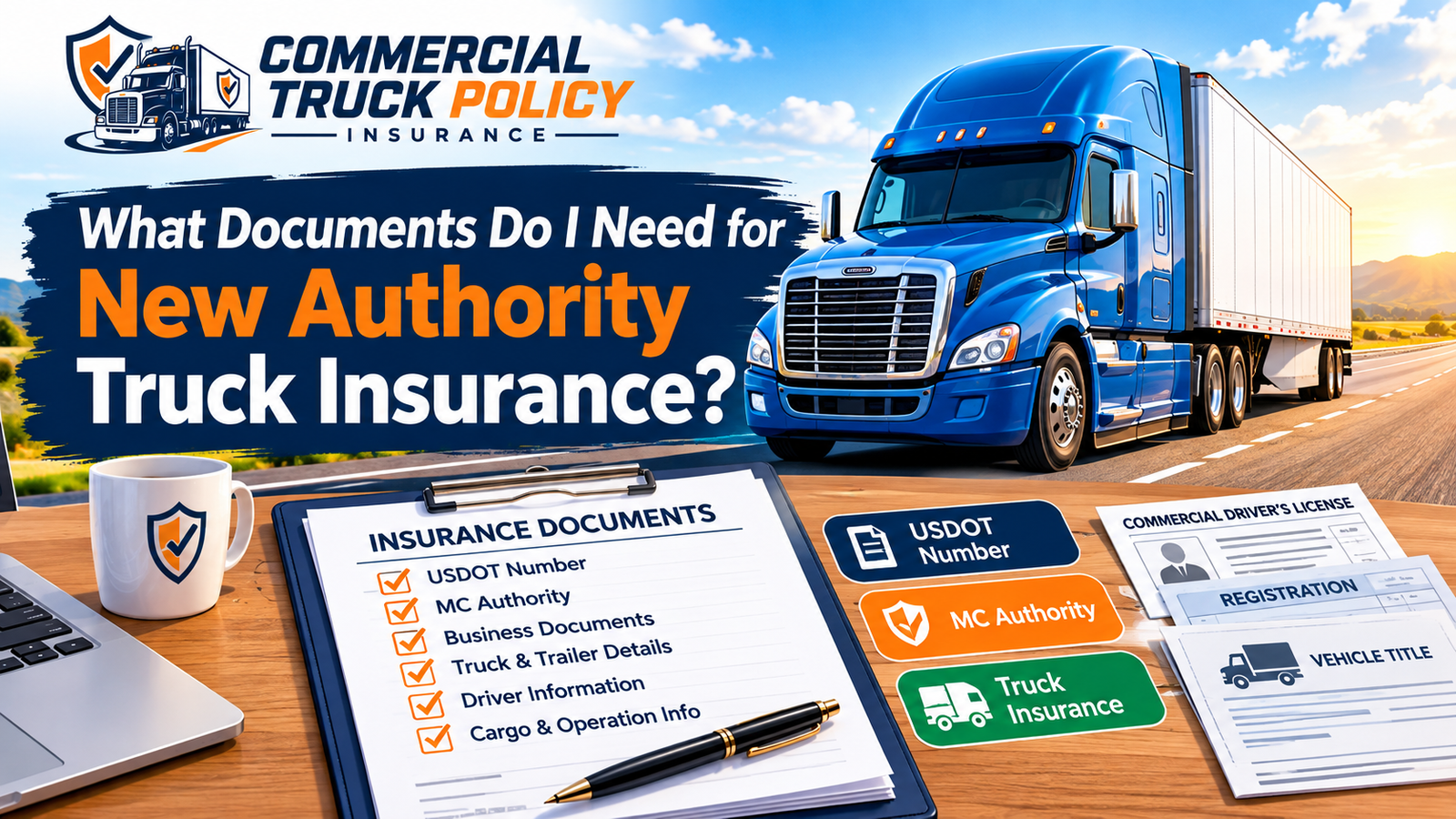
What Documents Do I Need for New Authority Truck Insurance?
Starting a new trucking business is an exciting step, but getting your first commercial truck insurance policy can feel confusing. If you are applying for your own motor carrier authority, an insurance company will need information about your business, truck, drivers, and the type of freight you plan to transport.
Many new trucking business owners ask the same question: What documents do I need for new authority truck insurance?
The good news is that preparing your paperwork before contacting an insurance agent can make the process easier. It also helps you provide accurate information, compare insurance quotes, and avoid unnecessary delays.
In this guide, we explain the documents commonly requested for new authority truck insurance, why insurers need them, and what you should check before purchasing a policy.
Whether you are an owner-operator buying your first semi-truck or starting a small trucking company with multiple vehicles, this guide will help you prepare.
1. USDOT Number and MC Authority Information
One of the first things you should prepare is your business’s USDOT and operating authority information.
The Federal Motor Carrier Safety Administration (FMCSA) regulates many interstate commercial trucking operations in the United States. Depending on your business activities, you may need a USDOT number, operating authority, or both.
Your insurance agent will generally ask for the following information:
- Your USDOT number, if applicable.
- Your MC number or other relevant operating authority information.
- Your business’s legal name.
- Your business address.
- The type of trucking operation you plan to run.
Your MC number is associated with your operating authority application. Having a number does not automatically mean your authority is active or that you can begin transporting freight.
Important: Make sure your business name and address match the information in your FMCSA registration records. Differences between your registration and insurance documents can delay the activation of your authority. The FMCSA explains its insurance filing requirements on its official Insurance Filing Requirements page.
If you are still applying for your authority, tell your insurance agent. They can explain when to arrange coverage and how the required insurance filing fits into the application process.
2. Business Registration Documents
Insurance companies need to understand who owns and operates the trucking business.
Depending on your business structure and the insurer’s requirements, you may be asked to provide business registration documents.
These may include:
- Articles of Incorporation for a corporation.
- LLC formation documents.
- Business registration records.
- Employer Identification Number (EIN), if applicable.
- Business address and contact information.
- Ownership information.
For example, suppose you have recently formed an LLC to operate a trucking company. Your insurance agent may ask for your LLC formation documents and EIN to verify the business information used for your insurance application.
If you operate as a sole proprietor, the required documents may differ.
You should also confirm that the business name on your insurance application matches the name associated with your operating authority.
Helpful tip: Prepare clear digital copies of your business documents before requesting insurance quotes. This makes it easier to send the same information to different insurance agents.
3. Truck Registration and Vehicle Information
Your truck is one of the most important parts of your commercial truck insurance application.
Insurance companies use vehicle information to evaluate the truck being insured and determine the appropriate coverage and premium.
Prepare the following information for each truck:
- Vehicle Identification Number (VIN).
- Year, make, and model.
- Truck registration.
- Gross Vehicle Weight Rating (GVWR).
- Vehicle ownership or financing information.
- Purchase information, if requested.
- Current mileage, if requested.
If you have already purchased a truck, your agent may ask for a copy of the registration or title.
If you have not purchased the truck yet, do not assume you must wait until the purchase is complete to discuss insurance. Many agents can begin discussing your options using the vehicle information available to you. Ask what documentation is required before the policy can be finalized.
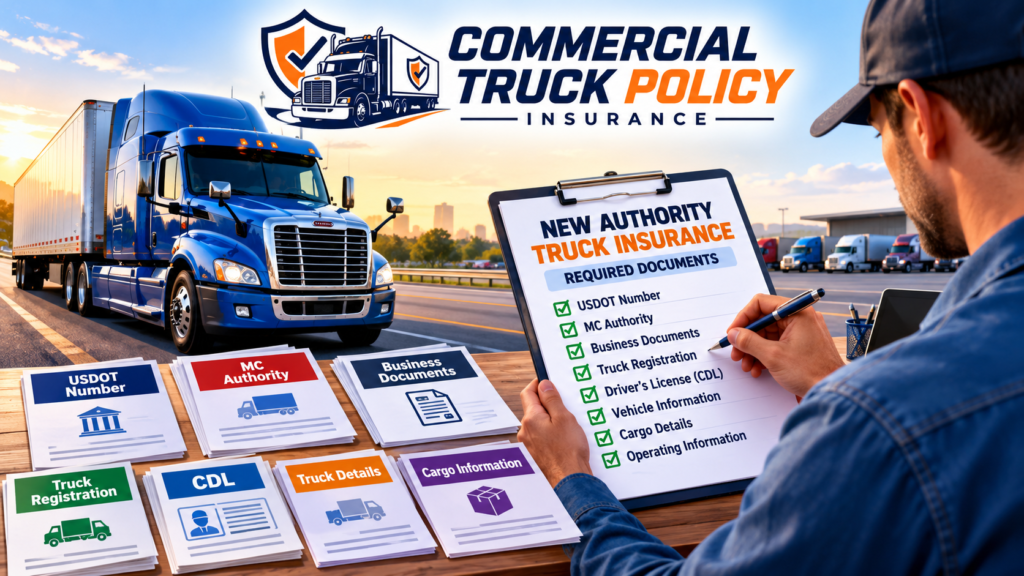
What if you are financing your truck?
If you financed your truck, your lender may require physical damage coverage to protect its financial interest in the vehicle.
Depending on the agreement, you may need comprehensive and collision coverage, often included in a commercial physical damage policy.
Tell your agent whether the truck is financed, leased, or owned outright. This information can affect the coverage you need.
4. Commercial Driver’s License and Driver Information
Insurance companies also need information about the people who will drive your commercial vehicles.
For a new trucking company, driver information is particularly important because you may not have an established operating history under your new authority.
Depending on the insurer, prepare:
- A copy of each driver’s commercial driver’s license (CDL), where applicable.
- Driver’s license number and state of issuance.
- Driving experience.
- Employment or driving history.
- Motor vehicle records (MVR), when requested or authorized.
- Relevant accident and violation history.
- Dates of birth, if requested through the insurer’s secure application process.
Not every commercial truck or operation requires a CDL. The applicable requirements depend on the vehicle, weight, cargo, and operation.
If you are the only driver, you may need to provide information about yourself. If you plan to hire drivers, your insurance company may need details about each driver before approving coverage.
Why is driving experience important?
Insurers may consider driving experience, previous claims, violations, and the type of truck being operated when evaluating a policy.
For example, an owner-operator with several years of commercial driving experience may receive different quotes from a new driver with limited experience.
Always provide accurate information about your driving history. Leaving out a driver or giving incorrect information could create serious problems if the insurer discovers the discrepancy.
5. CDL Experience and Previous Insurance History
Your new authority may be new, but you may already have experience driving commercially.
Some insurance companies ask about your previous employment, prior trucking policies, and claims history.
You may want to prepare:
- Previous commercial truck insurance declarations pages, if available.
- Loss runs or claims history, if requested.
- Details of previous trucking employment.
- Information about your previous role as an owner-operator or company driver.
- Your prior insurance cancellation or nonrenewal information, if applicable.
These documents are not mandatory for every applicant. The insurer will tell you which records are needed.
What if you have never owned a trucking company?
That does not automatically mean you cannot obtain insurance.
However, insurers may evaluate a new venture differently from an established trucking business. Your personal commercial driving experience, equipment, operating area, cargo, and other underwriting factors may affect eligibility and pricing.
Be prepared to explain your business plan and the experience you bring to the operation.
6. Information About the Freight You Will Transport
What you haul can affect your insurance requirements and the types of policies available to your business.
Before requesting a quote, prepare a clear description of your intended trucking operation.
Your agent may ask:
- What type of cargo will you transport?
- Will you haul general freight, refrigerated goods, building materials, or another commodity?
- Will you transport hazardous materials?
- Will you operate locally, regionally, or across state lines?
- What states or areas will you serve?
- How many miles do you expect to drive?
- Will you operate under your own authority or under another carrier’s authority?
For example, a business hauling general freight may have different insurance needs from one transporting hazardous materials.
Likewise, a refrigerated truck may require different equipment considerations from a standard dry van operation.
Provide realistic answers about your planned business. If your cargo or operating area changes later, contact your insurer to confirm whether your policy needs to be updated.
7. Estimated Mileage and Operating Radius
Insurance companies may ask how far you expect to travel and how much you plan to drive.
This information helps them understand your trucking operation.
Before requesting a quote, think about:
- Your typical one-way trip distance.
- Your expected annual mileage.
- Whether you will operate locally or interstate.
- The states where you plan to pick up and deliver freight.
- Whether your routes will change regularly.
For example, a company that primarily makes short regional deliveries may have a different risk profile from one that regularly travels across the United States.
You do not need to predict every trip perfectly. However, your estimates should reasonably reflect your planned operations.
Do not understate your mileage or operating radius just to obtain a lower premium. Inaccurate information can create coverage and underwriting problems.
8. Proof of Ownership or Purchase of the Truck
If you have purchased your truck, the insurance agent may ask for documents showing your ownership or purchase details.
Depending on your circumstances, these could include:
- Vehicle title.
- Current registration.
- Bill of sale.
- Purchase agreement.
- Lease agreement.
- Financing documents.
You may not need every document on this list. Requirements vary depending on the insurer, the vehicle, and whether the truck is owned, financed, or leased.
If you are buying a truck from a dealer, ask the insurance agent what information is needed to arrange coverage before you take possession of the vehicle.
This is particularly important if your lender requires proof of insurance before releasing the truck.
9. Details About Trailers and Additional Equipment
Not every trucking business owns its trailers. Some owner-operators pull trailers provided by customers, motor carriers, or other companies.
Tell your insurance agent how you plan to use trailers and other equipment.
You may need to provide:
- Trailer VIN, if applicable.
- Trailer ownership details.
- Trailer value.
- Lease or interchange agreements, where applicable.
- Information about any specialized equipment.
The coverage you need depends on your arrangement.
For example, trailer interchange coverage may be relevant when you haul non-owned trailers under a written interchange agreement. It is not automatically required for every trucking business.
If you own your trailer, ask whether it should be insured under your commercial physical damage policy or another suitable arrangement.
Do not assume the truck’s insurance automatically covers every trailer or piece of equipment you use.
10. Information Needed for a Commercial Truck Insurance Quote
Some documents prove that your business or vehicle exists. Other information helps the insurer understand the risks associated with your operation.
Before requesting a quote, prepare a short summary of your trucking business.
Include:
- Number of trucks.
- Number of drivers.
- Type of trucking operation.
- Cargo or commodities hauled.
- Operating states.
- Estimated mileage.
- Estimated annual revenue, if requested.
- Desired coverage limits.
- Whether you need coverage for owned or non-owned trailers.
You can send this information to several insurance agents to request comparable quotes.
When comparing quotes, make sure you are comparing similar coverage limits, deductibles, and policy terms.
A lower premium does not necessarily mean a better policy. One quote may exclude coverage or provide lower limits that another quote includes.
11. What Insurance Coverage Should a New Authority Trucking Company Consider?
Having the correct documents is only one part of getting insurance. You also need to understand which types of coverage may apply to your operation.
Here are some common commercial trucking insurance options.
Primary Auto Liability Insurance
Primary auto liability insurance helps cover eligible bodily injury and property damage liability arising from covered truck accidents, subject to the policy terms.
For many for-hire interstate property carriers, federal financial responsibility requirements apply.
The exact minimum depends on factors such as the type of operation, vehicle, and cargo. Certain hazardous-material operations have higher requirements.
For example, FMCSA lists a $750,000 minimum public liability requirement for many for-hire property carriers operating vehicles with a GVWR of 10,001 pounds or more while transporting non-hazardous property. Other operations may have different requirements. See the FMCSA insurance requirements for the applicable category.
Remember that a broker, freight forwarder, and motor carrier do not necessarily have the same insurance requirements.
Motor Truck Cargo Insurance
Motor truck cargo insurance may cover eligible loss or damage to freight you transport, subject to the policy’s terms, exclusions, and limits.
Some brokers and customers require cargo insurance before allowing a new carrier to haul loads.
The amount and type of cargo coverage you need will depend on the freight you transport and your contractual obligations.
Do not assume that every cargo policy covers every commodity or type of loss.
Physical Damage Insurance
Physical damage coverage can help pay for covered damage to your insured truck.
Depending on the policy, this may include collision and comprehensive coverage.
This insurance is particularly worth considering if you own an expensive truck or have a vehicle loan.
Review the deductible and insured vehicle value carefully before purchasing the policy.
General Liability Insurance
Commercial general liability insurance may help protect your business against certain third-party liability claims that are not covered by your primary auto liability policy.
Whether you need it depends on your operation, contracts, and other exposures.
Non-Trucking Liability or Trailer Interchange Coverage
These coverages address different risks and are not automatically necessary for every new authority carrier.
Non-trucking liability may be relevant to certain leased-on owner-operators during qualifying non-business use, depending on the policy and lease arrangement.
Trailer interchange coverage may be appropriate when you are responsible for non-owned trailers under a qualifying interchange agreement.
Ask an insurance professional to explain whether either coverage applies to your circumstances.
12. Do You Need to Submit the Insurance Forms to FMCSA Yourself?
This is an important question for new trucking business owners.
For many interstate motor carriers seeking operating authority, the insurance company or another authorized financial responsibility provider files the required proof of insurance electronically with FMCSA.
For example, BMC-91 or BMC-91X forms are used for applicable public liability insurance filings.
The required form depends on your operation and the financial responsibility arrangement.
FMCSA states that insurance forms must be filed by the insurance company or other appropriate filer, rather than by the motor carrier itself. You can read its official insurance forms FAQ.
You should still verify that the required filing has been accepted and that your authority status is correct.
What about the BOC-3 form?
The BOC-3 filing designates process agents who can receive legal documents on behalf of a motor carrier or other covered transportation entity.
It is separate from your truck insurance policy.
Depending on your authority application, you may need both the required insurance filing and the BOC-3 filing before your authority can become active.
You can learn more through the FMCSA registration forms page.
Important: Do not assume that purchasing a policy automatically makes your operating authority active. Check your FMCSA registration status and confirm that all applicable requirements have been satisfied before beginning operations.
13. How Can You Avoid Delays When Applying for New Authority Truck Insurance?
A few simple steps can make the application process smoother.
Check your business information. Make sure the legal name, address, and authority information you provide are accurate and consistent.
Prepare your truck details. Have the VIN, vehicle information, registration, and ownership details available.
Be honest about your drivers. Provide accurate driving histories and disclose the drivers who will operate your vehicles as required by the insurer.
Explain your cargo clearly. Do not describe your operation as general freight if you plan to haul commodities requiring different underwriting or coverage.
Ask about the down payment. New authority truck insurance may require a substantial initial payment. Ask about the down payment, monthly installments, fees, and payment schedule before committing.
Review the policy before paying. Confirm the coverage limits, deductibles, exclusions, covered vehicles, and effective date.
Verify your insurance filing. Ask your agent when the required FMCSA filing will be submitted and check the status afterward.
Taking these steps can help you avoid preventable mistakes and make a more informed insurance decision.
14. New Authority Truck Insurance Document Checklist
Before contacting an insurance agent, use this checklist to prepare your information.
| Document or Information | Why It May Be Needed |
|---|---|
| USDOT number | Identifies your motor carrier registration, when applicable |
| MC number or authority details | Helps identify your operating authority application |
| Business registration documents | Verifies your business structure |
| EIN, if applicable | Identifies your business for tax and registration purposes |
| Truck VIN | Identifies the vehicle to be insured |
| Truck registration or title | Helps verify vehicle details and ownership |
| Truck purchase or financing documents | May be needed to verify the purchase or lender requirements |
| CDL and driver information | Helps the insurer evaluate the drivers |
| Driving history | Supports underwriting, when requested |
| Previous insurance records | May help establish prior coverage and claims history |
| Cargo information | Helps determine appropriate coverage and eligibility |
| Mileage and operating radius | Helps the insurer understand your operations |
| Trailer information | Helps identify additional equipment and coverage needs |
| Lease or interchange agreement | May be needed for certain leased or non-owned equipment arrangements |
Remember: This is a preparation checklist, not a universal list of mandatory documents. Your insurance company may require additional information or may not need every item shown here.
Frequently Asked Questions
1. What documents do I need for new authority truck insurance?
You may need your USDOT and MC authority information, business registration records, truck VIN, vehicle registration, driver information, cargo details, and operating information. The exact requirements depend on your insurer and trucking operation.
2. Can I get truck insurance before my MC authority becomes active?
You can often begin discussing coverage and obtaining quotes while your authority application is in progress. The insurer can explain when coverage can be bound and when the required insurance filing should be submitted. Your authority must satisfy the applicable FMCSA requirements before you begin operations that require active authority.
3. Do I need a CDL to get commercial truck insurance?
Not every commercial truck operation requires a CDL. Requirements depend on factors such as vehicle weight, configuration, cargo, and applicable regulations. However, an insurer will generally need information about the person who will drive the insured truck.
4. Does new authority truck insurance cost more?
It can, but not in every case. Insurance companies may consider the newness of the business, driving experience, vehicle type, cargo, operating radius, claims history, and other underwriting factors. Obtain quotes from insurers familiar with new trucking businesses to understand your available options.
5. Is cargo insurance mandatory for every new trucking company?
No. Federal cargo insurance filing requirements differ by operation. For example, FMCSA generally requires evidence of cargo financial responsibility for for-hire interstate household goods carriers, while many other property carriers are not subject to the same federal cargo filing requirement. Customers and brokers may still require cargo coverage contractually.
6. Do I need physical damage insurance for my truck?
Federal operating authority requirements and physical damage coverage are different matters. Physical damage insurance may not be a universal federal operating authority requirement, but it can be important for protecting your truck. A lender may also require it under a financing agreement.
7. Can I pay for new authority truck insurance monthly?
Some insurers and payment plans offer installment options, but availability, down payment, fees, and payment schedules vary. Ask your agent to explain the total cost and the conditions of the payment plan before choosing a policy.
8. How long does it take for insurance to appear in FMCSA records?
The timing can vary depending on the insurer’s filing, FMCSA processing, and whether the application has other outstanding requirements. Ask your insurance provider to confirm that the filing was submitted, then check the official FMCSA Licensing and Insurance system for your status.
Final Thoughts
Getting new authority truck insurance is easier when you prepare the right information before requesting a quote.
Start with your USDOT and MC authority details, business records, truck information, driver history, and cargo plans. Then ask your insurance agent which additional documents are needed for your specific operation.
Remember that the cheapest policy is not always the best choice. Compare coverage limits, deductibles, exclusions, payment terms, and the insurer’s suitability for your business.
Most importantly, verify that the required insurance and other authority filings have been completed before beginning operations.
At Commercial Truck Policy, our goal is to help trucking business owners understand insurance requirements and make better-informed decisions. Prepare your documents, ask questions, and choose coverage that fits your business.
Disclaimer: This article is for general educational purposes only and does not constitute legal or insurance advice. Requirements and coverage options vary by operation, jurisdiction, insurer, and policy. Verify current requirements with FMCSA and consult a qualified insurance professional regarding your specific circumstances.
Can a New Trucking Company Get Monthly Insurance Payments?
How Long Does It Take to Get Truck Insurance After Getting MC Number?