
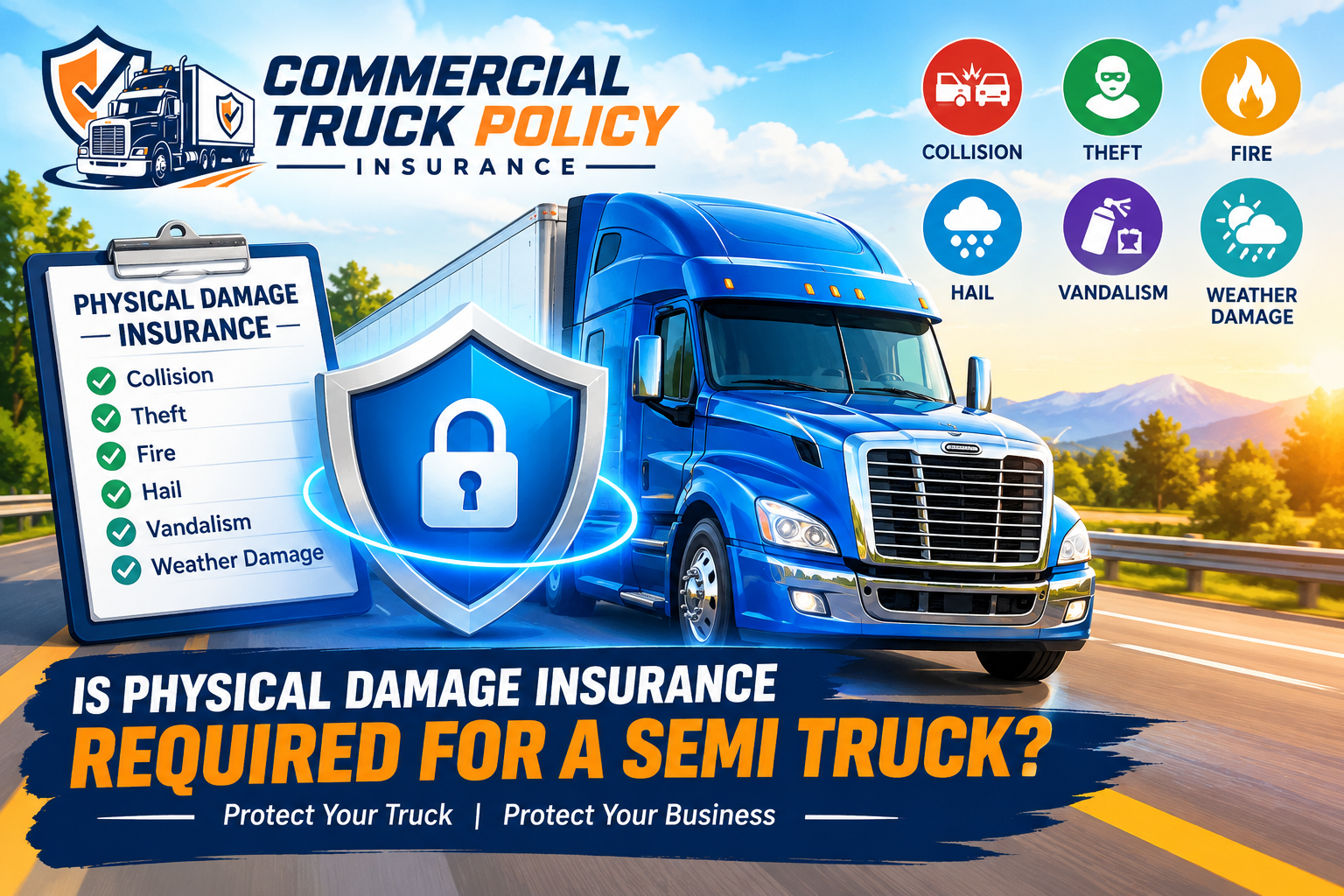
Is Physical Damage Insurance Required for a Semi Truck?
Owning a semi truck is a major investment. Whether you are an owner-operator with one truck or a trucking company managing a fleet, protecting your equipment is an important part of running your business.
Imagine you are driving your semi truck on the highway when another vehicle suddenly cuts in front of you. You brake hard, lose control, and your truck hits a guardrail. The accident damages your truck, and the repair bill reaches thousands of dollars.
Now comes an important question: Who will pay for the damage to your truck?
This is where physical damage insurance can help. It is designed to protect your truck against covered losses caused by events such as accidents, theft, fire, and certain types of weather damage, depending on your policy.
But is physical damage insurance required for a semi truck by law, or is it optional? Let’s look at what truck owners need to know.
What Is Physical Damage Insurance for a Semi Truck?
Physical damage insurance is a type of commercial truck insurance that helps pay to repair or replace your insured truck when it suffers covered physical damage.
Unlike liability insurance, which generally covers injuries or property damage you cause to others, physical damage coverage protects your own insured vehicle.
For example, if your semi truck is damaged in a covered collision, physical damage insurance may help pay for repairs after you meet your deductible.
Physical damage insurance commonly includes two types of coverage:
1. Collision Coverage
Collision coverage helps pay for covered damage to your truck resulting from a collision with another vehicle or object, or from a rollover, subject to the policy terms.
Examples include:
- Your semi truck hits another vehicle.
- You accidentally strike a guardrail.
- Your truck rolls over during an accident.
- You collide with a stationary object while maneuvering.
2. Comprehensive Coverage
Comprehensive coverage generally helps protect your truck against certain types of damage that do not result from a collision.
Depending on the policy, covered events may include:
- Truck theft.
- Fire damage.
- Hail damage.
- Falling objects.
- Certain weather-related losses.
- Vandalism.
Coverage varies by insurer and policy. Always check the actual policy wording, exclusions, and limitations before purchasing insurance.
Is Physical Damage Insurance Required for a Semi Truck by Law?
Generally, physical damage insurance is not required by federal law simply because you own or operate a semi truck.
Federal motor carrier regulations establish financial responsibility requirements for covered motor carriers, including applicable public liability insurance requirements. Physical damage coverage for your own truck is a different type of protection. See the Federal Motor Carrier Safety Administration’s insurance information.
However, this does not mean every truck owner can operate without physical damage insurance.
A lender, leasing company, motor carrier, or other contracting party may require you to carry it under the terms of your financing, lease, or business agreement.
State requirements and the details of your operation can also affect your overall insurance obligations.
Before deciding that physical damage insurance is optional for your situation, check your specific requirements with a licensed commercial truck insurance agent.
When Is Physical Damage Insurance Required?
Physical damage insurance may be required in the following situations.
1. When You Finance Your Semi Truck
If you purchase a semi truck using a commercial vehicle loan, your lender may require physical damage coverage for the duration of the loan.
The lender has a financial interest in the vehicle. If the truck is severely damaged or stolen, insurance helps protect that interest.
Your financing agreement may specify the types and limits of coverage you must maintain.
2. When You Lease a Semi Truck
If you lease a truck, the leasing company may require collision and comprehensive coverage.
The exact requirements depend on your lease agreement. Some agreements also specify deductible limits and how the insurance policy must identify the leasing company.
Read the agreement carefully before signing it.
3. When Your Motor Carrier Requires Coverage
Owner-operators working under another motor carrier may have to meet that company’s insurance requirements.
These requirements depend on the lease agreement, equipment ownership, and responsibility for insuring the truck.
If you are an owner-operator, ask the carrier whether you must purchase your own physical damage policy or whether any coverage is available through its insurance arrangements.
Do not assume the motor carrier’s policy automatically protects your truck.
What Happens If You Do Not Have Physical Damage Insurance?
Suppose you own your semi truck outright and have no loan or lease requiring physical damage coverage.
You may be able to operate without this particular coverage, provided you satisfy all applicable legal and contractual requirements.
However, going without it means you could be responsible for paying for damage to your own truck.
Consider these examples.
Example 1: Your Truck Is Damaged in an Accident
You accidentally hit a barrier while driving your semi truck. The repair estimate is $18,000.
If you have applicable collision coverage, your insurer may pay the covered repair costs after the deductible.
Without that coverage, you generally have to pay for repairs yourself unless another party is legally responsible and you can recover the loss from that party or its insurer.
Example 2: Your Truck Is Stolen
You park your truck overnight, but the next morning it is gone.
If your policy covers theft under comprehensive coverage, your insurer may compensate you according to the policy terms and the truck’s covered value.
Without applicable coverage, you could face a substantial financial loss.
Example 3: A Hailstorm Damages Your Truck
A severe hailstorm damages your truck’s cab and other exterior components.
If the damage is covered under your comprehensive policy, insurance may help pay for the repairs, subject to the deductible and other policy provisions.
Without that coverage, the repair costs may come directly out of your business funds.
These examples illustrate why physical damage insurance can be valuable even when it is not legally mandatory.
What Does Semi Truck Physical Damage Insurance Cover?
The exact protection depends on your policy, but physical damage insurance commonly covers eligible damage to the insured vehicle.
Here are some situations to discuss with your insurance agent.
| Type of loss | Potential coverage |
|---|---|
| Collision with another vehicle | Collision coverage |
| Rollover accident | Collision coverage |
| Impact with a guardrail | Collision coverage |
| Theft of the insured truck | Comprehensive coverage |
| Fire damage | Comprehensive coverage |
| Hail damage | Comprehensive coverage |
| Vandalism | Comprehensive coverage |
Coverage is never automatic simply because an event appears in this table. Policy exclusions, conditions, deductibles, and other provisions determine whether a particular claim is covered.
Also, physical damage insurance for the tractor does not necessarily insure every trailer, tool, piece of equipment, or load associated with your trucking business.
If you need protection for trailers or transported freight, ask your agent about the appropriate coverage.
What Is the Difference Between Physical Damage and Liability Insurance?
New trucking companies sometimes confuse physical damage insurance with commercial auto liability insurance.
Although both can be part of a commercial truck insurance program, they serve different purposes.
| Feature | Physical Damage Insurance | Commercial Auto Liability Insurance |
|---|---|---|
| Main purpose | Protects your insured truck against covered physical losses | Protects against covered liability to other parties |
| Damage to your truck | May be covered | Generally not covered |
| Damage to another person’s property | Not its primary purpose | May be covered when you are legally liable |
| Injuries to other people | Not its primary purpose | May be covered, subject to policy terms |
| Required by federal law | Generally not required solely because the vehicle is a semi truck | Required for applicable regulated motor carrier operations |
| Required by a lender | Often required when financing a truck | May also be required |
For applicable interstate motor carriers, federal financial responsibility requirements include public liability insurance. The specific requirements depend on the type of operation and other relevant factors. See 49 U.S.C. § 13906.
Remember, liability insurance and physical damage insurance are not interchangeable. One does not automatically replace the other.
How Much Does Physical Damage Insurance Cost for a Semi Truck?
The cost of semi truck physical damage insurance varies from one trucking business to another.
There is no single price that applies to every truck.
Insurance companies may consider several factors when calculating your premium.
1. Value of the Truck
A newer or more expensive semi truck may cost more to insure because repairing or replacing it could be more expensive.
2. Truck Age and Condition
The vehicle’s age, condition, specifications, and insured value can affect the premium.
3. Driving and Claims History
Your driving record and previous insurance claims may influence the insurer’s assessment of risk.
4. Deductible Amount
The deductible is the amount you are generally responsible for paying toward a covered claim.
A higher deductible may reduce your premium, but it also means you could have to pay more out of pocket when a covered loss occurs.
5. Operating and Parking Locations
Where you operate and regularly park your truck may influence the insurer’s assessment of theft, accident, and other risks.
6. Coverage Selection
Your selected coverage, insured value, deductible, and policy terms all matter.
How Can You Find an Affordable Physical Damage Insurance Policy?
If you want to control insurance costs without leaving your truck unnecessarily exposed, consider these steps:
- Compare quotes from multiple commercial truck insurance providers.
- Give each insurer accurate information about your truck and business.
- Ask how the insurer determines the truck’s insured value.
- Compare deductibles before choosing a policy.
- Review exclusions and claim settlement terms.
- Ask whether available discounts apply to your situation.
- Check whether your lender requires a particular coverage level.
Do not compare policies by premium alone. A cheaper policy may have a higher deductible, narrower coverage, or exclusions that matter to your business.
The goal is to find coverage that fits your truck’s value, financial situation, and operating needs.
How Much Physical Damage Coverage Should You Carry?
The appropriate coverage amount depends on the value of your semi truck and the requirements of your financing or lease agreement.
For example, suppose your truck has an agreed or otherwise insured value of $90,000. You should understand how your insurer determines the amount payable for a covered total loss.
Some policies settle covered losses using actual cash value, while other arrangements may use different valuation methods. The policy language controls.
Ask your agent these questions before buying coverage:
- How is the value of my truck determined?
- What happens if my truck is declared a total loss?
- Is depreciation considered when calculating the claim payment?
- What deductible applies to collision and comprehensive claims?
- Are permanently installed accessories and equipment covered?
- Does the policy meet my lender’s requirements?
- Are there any exclusions I should understand?
Getting clear answers before an accident can help prevent unpleasant surprises later.
Is Physical Damage Insurance Worth It for an Owner-Operator?
For many owner-operators, physical damage insurance is worth considering because the truck is one of their most important business assets.
However, the right decision depends on your financial position and risk tolerance.
Physical Damage Insurance May Be Especially Important If:
- You are still paying off a truck loan.
- Your truck is relatively new or expensive to replace.
- Your business depends on one truck for most of its income.
- You would struggle to pay a large repair bill out of pocket.
- You want protection against covered theft and non-collision losses.
What If You Own Your Truck Outright?
If your truck is fully paid off, you may have more flexibility when deciding whether to purchase physical damage coverage.
But ownership does not eliminate the financial risk.
Consider whether you could afford to repair or replace the truck after a major accident or theft. Also, check whether any lease, carrier agreement, or other contract still requires coverage.
If you have enough financial resources to absorb a loss, you may decide to accept more risk yourself. If replacing the truck would seriously affect your business, insurance may provide valuable financial protection.
Discuss your options with a licensed commercial truck insurance professional before making a final decision.
What Other Insurance Should a Semi Truck Owner Consider?
Physical damage coverage is only one part of a commercial trucking insurance plan.
Depending on your operation, you may also need or benefit from the following coverages.
Commercial Auto Liability Insurance: Helps cover qualifying bodily injury and property damage liability arising from covered accidents for which you are legally responsible.
Motor Truck Cargo Insurance: May protect against covered loss of or damage to freight you transport. Requirements depend on your operation, contracts, and applicable law. The FMCSA identifies household goods carriers and household goods freight forwarders as categories required to carry cargo insurance under its rules. Read the FMCSA’s cargo insurance FAQ.
General Liability Insurance: May cover certain third-party bodily injury, property damage, and other liabilities arising from business activities, subject to policy terms.
Trailer Interchange Coverage: May help protect against covered physical damage to a non-owned trailer in your possession under a qualifying trailer interchange agreement.
Non-Trucking Liability Insurance: May provide liability protection for certain personal or non-business use of a leased truck, depending on the policy and circumstances.
Not every truck owner needs every type of coverage. Your insurance needs depend on how you operate, who owns the equipment, what you haul, and which agreements apply to your business.
Frequently Asked Questions
1. Is physical damage insurance mandatory for a semi truck?
Generally, federal law does not require physical damage insurance solely because a vehicle is a semi truck. However, lenders, leasing companies, and motor carriers may require it under their agreements. Other applicable requirements should also be checked.
2. Can I drive my semi truck without physical damage insurance?
You may be able to operate without physical damage insurance if you meet all applicable legal and contractual requirements. However, you could be responsible for paying for damage to your own truck if you do not have applicable coverage.
3. Does liability insurance cover damage to my own semi truck?
Generally, no. Commercial auto liability insurance is designed primarily to address covered liability to other parties. Physical damage coverage is generally used to insure your own truck against covered physical losses.
4. Does physical damage insurance cover theft?
Theft is commonly covered under the comprehensive portion of a physical damage policy, subject to the policy’s terms, conditions, and exclusions.
5. Does physical damage insurance cover trailer damage?
Not necessarily. Coverage depends on the insured equipment and policy terms. If you own a trailer or use a trailer owned by someone else, ask your insurance agent whether separate trailer physical damage or trailer interchange coverage is appropriate.
6. Is physical damage insurance required when a semi truck is fully paid off?
Not necessarily. Paying off the truck removes the lender’s loan-related requirements, but other contractual obligations may remain. You should also consider whether you can afford to repair or replace the truck without insurance.
7. Can I choose a higher deductible to reduce my premium?
A higher deductible may reduce your premium, depending on the insurer and policy. However, you would generally pay more out of pocket for a covered claim. Make sure you can comfortably afford the deductible you select.
8. Does physical damage insurance cover engine failure?
Ordinary mechanical breakdown or wear and tear is generally not covered by standard physical damage insurance. Coverage depends on the cause of the damage and the policy’s exclusions. Ask your insurer about mechanical breakdown protection if you need it.
Final Thoughts
So, is physical damage insurance required for a semi truck?
In general, no. Federal law does not require physical damage coverage simply because you own or operate a semi truck. However, your lender, leasing company, motor carrier, or another contractual party may require it.
Even when coverage is optional, it can help protect one of your business’s most valuable assets against covered accidents, theft, fire, and other losses.
Before choosing a policy, compare quotes, review deductibles, understand how claims are settled, and confirm which equipment is insured.
A little preparation today can help you make a more informed decision about protecting your truck and keeping your business moving.
New Authority Truck Insurance Down Payment: What to Expect in 2026
How Long Does It Take to Get Truck Insurance After Getting MC Number?