
How Long Does It Take to Get Truck Insurance After Getting an MC Number?
Getting an MC number is an important step when starting a trucking business in the United States. But receiving an MC number does not mean that your trucking operation is automatically ready to start hauling loads.
One of the next major steps is getting the appropriate commercial truck insurance and making sure the required insurance filing is submitted to the Federal Motor Carrier Safety Administration (FMCSA).
So, how long does it take to get truck insurance after getting an MC number?
In many cases, an insurance quote can be obtained quickly, and a policy can potentially be bound the same day once the insurer has the required information and accepts the risk. However, the overall process can take longer when additional documents, underwriting, driver verification, vehicle information, or corrections are needed.
This guide explains what usually happens after receiving an MC number, what can delay the process, and what new trucking companies should prepare before contacting an insurance agent.
What Is an MC Number?
An MC number, commonly called an operating authority number, is associated with certain interstate motor carrier operations regulated by FMCSA.
Generally, companies transporting federally regulated commodities owned by others for compensation in interstate commerce may need operating authority in addition to a USDOT number. The type of authority a company applies for can also affect its insurance and financial responsibility requirements.
However, having an MC number by itself does not mean that your authority is ready for operation.
Your business may still need to satisfy requirements such as:
- Appropriate commercial truck insurance
- Required FMCSA insurance filing
- BOC-3 process agent filing
- Other applicable registration requirements
FMCSA states that operating authority will not be granted until the required financial responsibility is on file.
How Quickly Can You Get Truck Insurance After an MC Number?
There is no single guaranteed timeframe for every trucking company.
If you already have your business information, truck details, driver information, and required documents ready, an insurance agent may be able to provide quotes quickly. In some situations, coverage can be bound shortly after the application is completed and approved by the insurance company.
However, getting a quote is not necessarily the same thing as completing the FMCSA insurance filing.
A typical process may look like this:
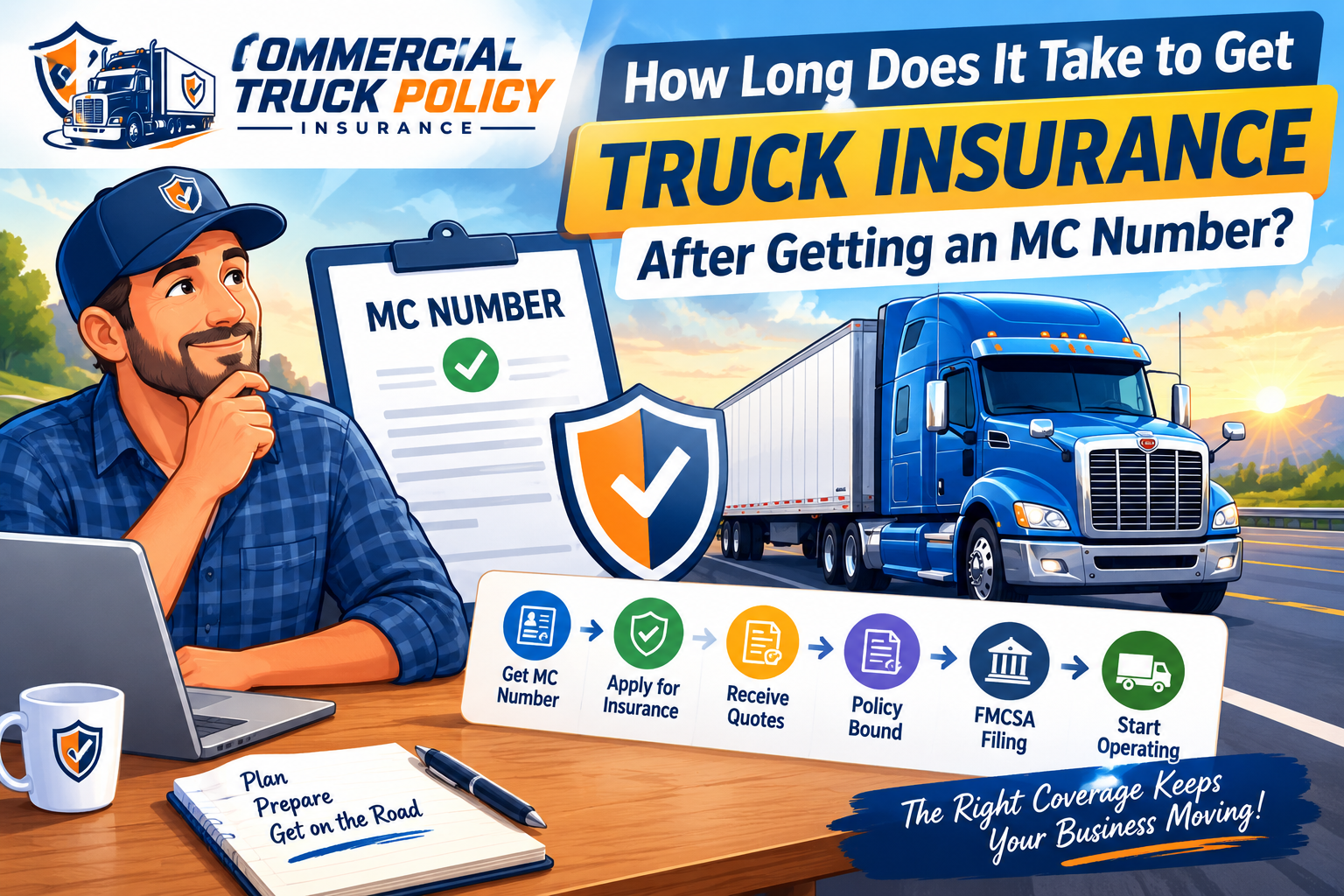
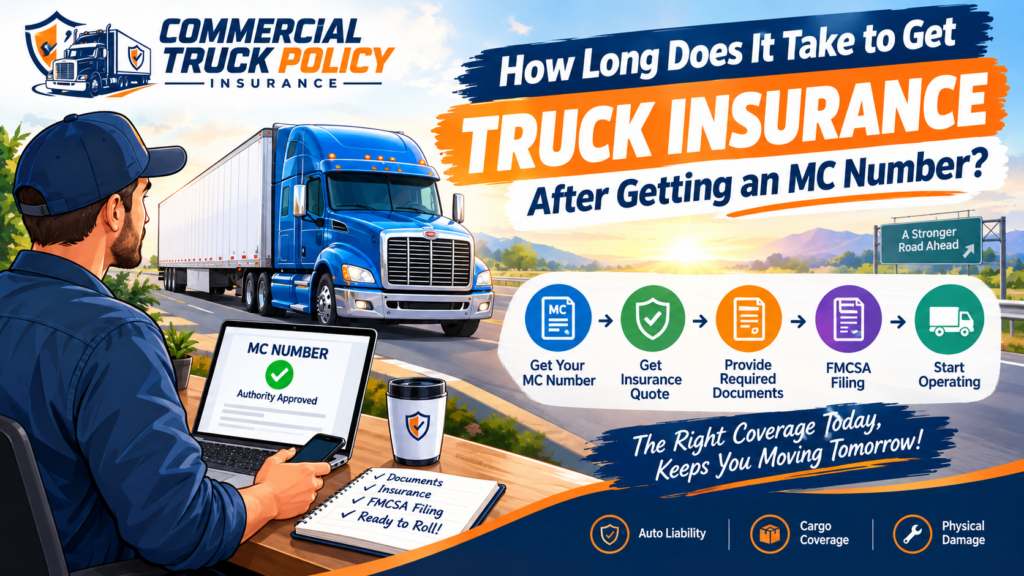
MC number received → Insurance application → Quotes → Choose coverage → Underwriting → Policy bound → Insurance filing submitted → Authority requirements completed
The exact timing depends on the insurance company, the type of trucking operation, the driver’s history, the equipment, the cargo, and the information provided in the application.
Can I Get a Truck Insurance Quote on the Same Day?
Yes, it may be possible to receive a commercial truck insurance quote on the same day.
Some insurance agencies can begin the quoting process as soon as they receive the necessary information. However, the speed of the quote does not guarantee that the policy will be issued immediately.
An insurer may need to review:
- Driver’s license information
- Driving history
- Truck information
- Vehicle value
- Business experience
- Operating radius
- Type of cargo
- Annual mileage
- Previous insurance history
- Loss or claims history
- USDOT and MC information
- Business ownership information
If something is missing or needs clarification, underwriting can take longer.
How Long Does It Take to Activate Truck Insurance?
The insurance policy itself may be bound quickly after the insurer approves the application and the required payment or down payment is completed.
But the timing can vary significantly between insurance companies.
For example, a new trucking company with one truck, an experienced driver, straightforward operations, and complete documentation may have a simpler underwriting process than a new carrier with multiple vehicles, inexperienced drivers, unusual cargo, or a complicated operating profile.
This is why it is better not to plan your first load around an assumption that insurance will always be completed within a few hours.
Give yourself enough time for underwriting and FMCSA filing.
What Information Does an Insurance Agent Need?
Having your documents ready can make the insurance process much smoother.
A trucking insurance agent may ask for information such as:
1. MC Number and USDOT Number
Your MC and USDOT information helps the insurance agent understand your authority and operating profile.
2. Business Information
You may need to provide:
- Legal business name
- DBA, if applicable
- Business address
- Entity type
- Contact information
- EIN
- Years in business
Make sure the business information is consistent across your FMCSA registration, state records, and insurance application.
FMCSA specifically cautions applicants to make sure business name and address information matches across registration filings because differences can cause delays.
3. Truck Information
The insurance company may request:
- Year
- Make
- Model
- VIN
- Purchase price or vehicle value
- Type of truck
- Trailer information
If you are financing the truck, the lender may also have insurance requirements.
4. Driver Information
Driver information can have a major effect on underwriting.
You may be asked for:
- Driver’s license
- CDL information
- Driving history
- Years of experience
- Previous commercial driving experience
- Accident history
- Violation history
It is important to provide accurate information. Trying to leave out relevant driver or business information to obtain a lower premium can create serious problems later.
5. Type of Cargo
Tell the insurer exactly what you plan to haul.
For example, your insurance needs may be different depending on whether you transport:
- General freight
- Household goods
- Auto parts
- Machinery
- Refrigerated products
- Specialized equipment
- Other commodities
The cargo you carry can affect both the insurance requirements and the underwriting process.
Does Every Trucking Company Need the Same Insurance?
No.
Insurance requirements depend on factors such as the type of entity, operating authority, cargo, and vehicle.
FMCSA’s insurance filing chart shows different financial responsibility requirements depending on the operation. For example, certain for-hire property carriers with vehicles at or above 10,001 pounds GVWR have a $750,000 federal BIPD requirement, while certain other operations have different requirements.
That is why a new trucking company should not simply copy another carrier’s insurance coverage.
Your insurance should be based on your actual operation and applicable requirements.
What Is the FMCSA Insurance Filing?
The insurance policy and the FMCSA filing are related, but they are not exactly the same thing.
The insurance company or another registered financial responsibility filer generally submits the required insurance forms electronically to FMCSA.
FMCSA states that public liability insurance forms such as BMC-91 or BMC-91X must be submitted electronically by a registered filer.
This means a carrier normally does not simply upload a regular insurance certificate and consider the FMCSA requirement finished.
Your insurance provider needs to make the appropriate filing.
How Long Does the FMCSA Insurance Filing Take?
The filing timeline can depend on the insurance company, filing system, and whether the information is correct.
A common reason for delay is a mismatch between the business information on the insurance application and the information in FMCSA records.
For example, if the legal company name or address is entered differently, the filing may require correction.
Before purchasing your policy, check that important information is accurate.
What About the BOC-3 Filing?
Insurance is only one part of completing the operating authority process.
A BOC-3, or Designation of Process Agents, is another requirement associated with operating authority.
FMCSA explains that operating authority applicants need both the required financial responsibility and a BOC-3 filing before the authority can be granted.
Therefore, getting truck insurance is important, but it should be considered part of a larger authority-completion process.
Why Can Truck Insurance Take Longer Than Expected?
Several issues can slow down the process.
Incomplete Information
Missing driver, vehicle, business, or authority information can result in additional questions.
Driver History
A complicated driving history may require additional underwriting review.
New Business
A brand-new trucking company may require additional information because there may be limited prior commercial insurance history.
Incorrect Business Information
Differences in legal name, address, or other registration information can create problems.
Special Cargo
Certain cargo types can require different underwriting or insurance considerations.
Multiple Trucks or Drivers
More vehicles and drivers can mean more information for the insurer to review.
Previous Claims
A history of claims may require additional underwriting questions.
Should You Buy Insurance Before Getting Your MC Number?
It is a good idea to start discussing insurance before you actually need to operate.
Many new carriers contact an insurance agent while their authority application is being processed so they can understand what coverage they may need and what information will be required.
FMCSA specifically advises new entities to be prepared to contact their financial responsibility provider immediately after obtaining their designated docket number.
Planning ahead can prevent unnecessary last-minute pressure.
However, the exact timing for binding coverage should be coordinated with your insurance agent and your planned operating date.
Can I Start Hauling Loads Immediately After Getting Insurance?
Not necessarily.
Getting an insurance policy does not automatically mean every FMCSA requirement has been completed.
Before starting operations, verify that your operating authority and required filings are in the appropriate status.
FMCSA provides an online method for checking authority status using the MC or USDOT number.
Do not assume that because you received an MC number, you can immediately begin interstate for-hire operations.
How Can I Speed Up the Insurance Process?
You can make the process easier by preparing everything before contacting an insurance agent.
Keep these items ready:
- MC number
- USDOT number
- Legal business name
- Business address
- EIN
- Truck VIN
- Truck year, make, and model
- Vehicle value
- Driver information
- CDL information
- Driving history
- Cargo description
- Operating radius
- Expected annual mileage
- Previous insurance information
- Claims history, if applicable
- Desired coverage information
Also, answer the insurer’s questions accurately.
Providing incomplete or incorrect information may save a little time initially but can create much bigger problems during underwriting or a future claim.
How Much Does New Truck Insurance Cost?
The price of commercial truck insurance is different for every business.
There is no single price that applies to all new MC carriers.
Premiums can be influenced by factors such as:
- Type of truck
- Number of vehicles
- Driver experience
- Driving record
- Location
- Operating radius
- Cargo
- Coverage limits
- Deductibles
- Claims history
- Business experience
- Insurance history
Because of these differences, it is usually more useful to obtain quotes based on your actual operation rather than relying on a general online estimate.
A Simple Example
Suppose you receive your MC number on Monday.
You already have your truck information, driver documents, business details, and cargo information ready.
You contact an insurance agent and submit your application.
The agent obtains quotes and sends them to you. You select a policy, complete the required payment, and the insurance company approves the policy.
The insurer then submits the required FMCSA insurance filing.
In this situation, the process may move relatively quickly.
But if the insurer needs additional driver records, clarification about your operation, corrected business information, or additional underwriting review, the process can take longer.
The key point is that there is no universal “X hours” rule for obtaining truck insurance after an MC number.
Frequently Asked Questions
How long does it take to get truck insurance after getting an MC number?
It can vary. A straightforward application with complete information may move quickly, while underwriting or documentation issues can extend the process.
Can I get commercial truck insurance the same day?
In some cases, yes. Same-day quoting or binding may be possible, but it depends on the insurance company and whether the application can be approved without additional review.
Does getting an MC number mean I have insurance?
No. An MC number and commercial truck insurance are separate parts of the process.
Does FMCSA require insurance before granting operating authority?
FMCSA states that required financial responsibility must be on file before operating authority is granted.
Do I need a BOC-3?
For applicable operating authority registrations, a BOC-3 process agent designation is part of the authority requirements.
Can insurance delays affect my authority?
Yes. If required insurance evidence is not properly filed, the authority process can be delayed or, if requirements are not met within the applicable period, the application can be dismissed.
Should I compare truck insurance quotes?
Comparing quotes can help you understand differences in premium, deductible, limits, and coverage. However, the cheapest quote is not automatically the right choice for every trucking business. Review the actual coverage and exclusions before making a decision.
Final Thoughts
Getting an MC number is an important milestone for a new trucking company, but it is only one part of becoming ready to operate.
Truck insurance can sometimes be arranged quickly when the application is complete and the insurer can approve the risk without additional questions. However, the total process can take longer when driver history, vehicle information, business details, cargo, or FMCSA filings require additional attention.
The best approach is to prepare your documents early, provide accurate information, and work with your insurance provider to make sure the required filing is completed.
Most importantly, do not confuse receiving an MC number with having a fully active operating authority. Check your FMCSA status and make sure the required insurance and other filings are properly completed before beginning operations.
This article is for general educational purposes and is not legal or insurance advice. Federal and state requirements can vary based on your operation, cargo, vehicle, and authority type. Always verify current requirements with FMCSA and your licensed insurance professional.
What Insurance Do I Need for a New MC Number?
Can I Get Truck Insurance Before Getting My Authority?