
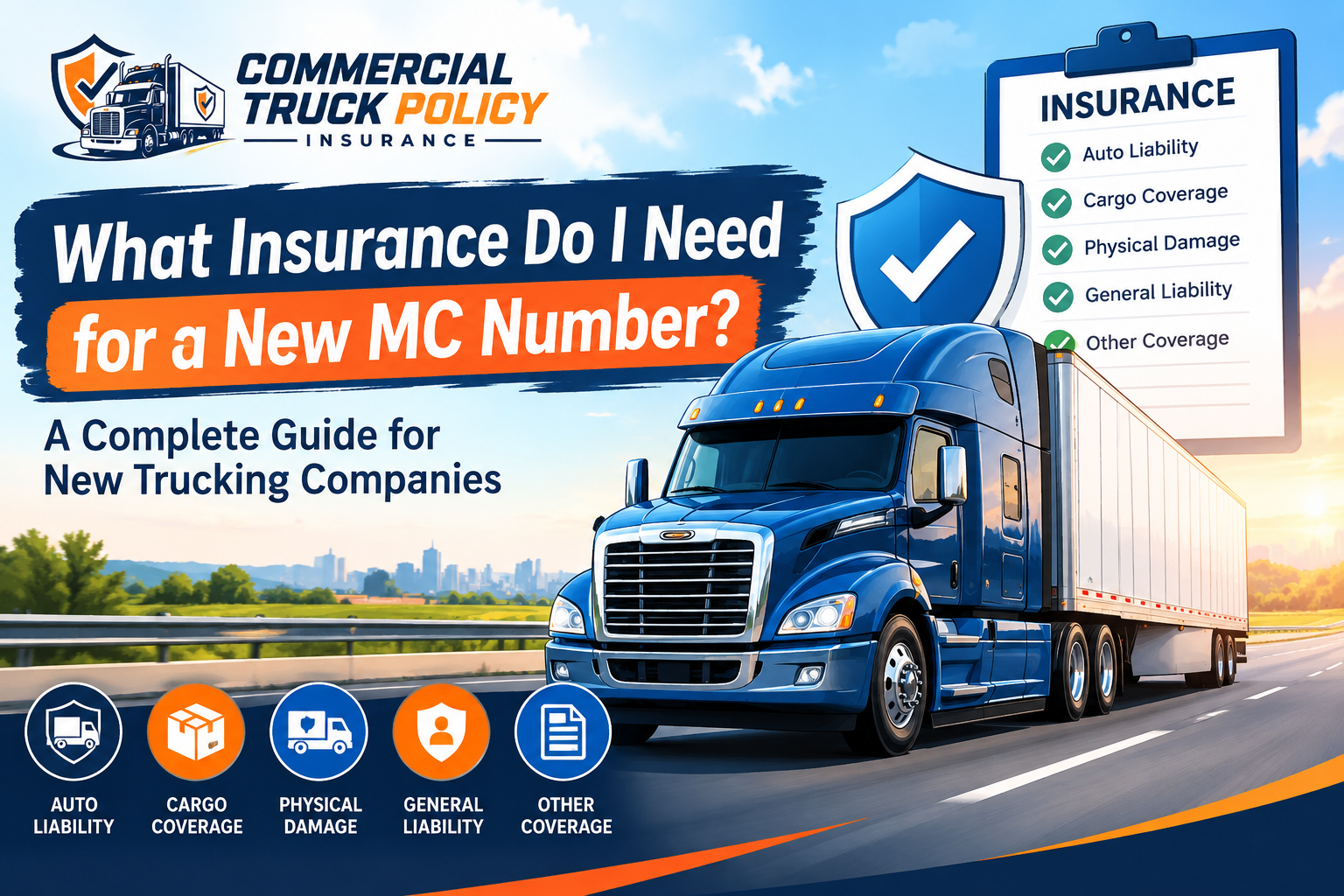
What Insurance Do I Need for a New MC Number? A Complete Guide for New Trucking Companies
Starting a trucking company is exciting, but getting a new MC number comes with important responsibilities. One of the biggest questions new owner-operators and trucking companies ask is:
“What insurance do I need for a new MC number?”
The answer depends on several factors, including the type of authority you apply for, the cargo you haul, your vehicle weight, and whether you operate interstate.
For most new for-hire trucking companies hauling general freight across state lines, commercial auto liability insurance is one of the most important requirements. However, many trucking businesses also choose additional coverage to protect their truck, cargo, and business.
This guide explains the most important insurance coverage for a new MC number in simple terms.
Important: Insurance requirements can vary depending on your operation and authority type. Always confirm your exact requirements with FMCSA and a licensed commercial insurance professional.
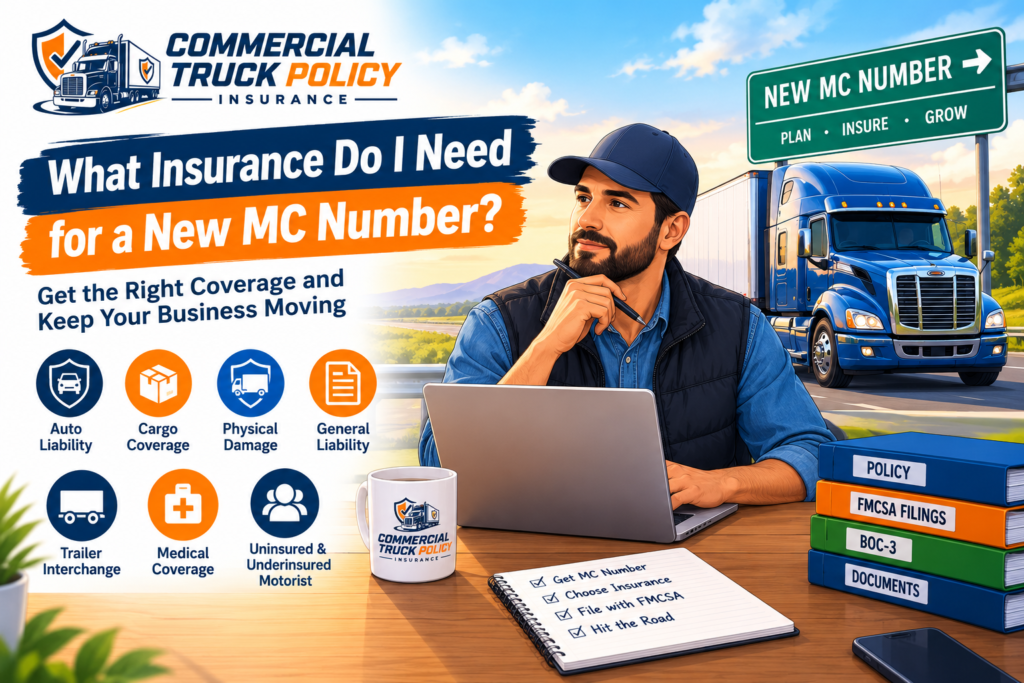
What Is an MC Number?
An MC number is commonly associated with FMCSA operating authority for certain interstate transportation businesses.
In general, companies that operate as for-hire carriers and transport federally regulated commodities across state lines may need operating authority in addition to a USDOT number. The type of authority you need depends on your business operations and the type of freight you transport.
When you apply for operating authority, FMCSA may require proof that you have the appropriate financial responsibility or insurance filing before your authority becomes active.
1. Commercial Auto Liability Insurance
The Most Important Coverage for Most New MC Numbers
For many new trucking companies, commercial auto liability insurance is the primary insurance requirement.
This coverage generally helps protect you if your truck causes bodily injury or property damage to another person.
For example:
Imagine you are driving your semi-truck on the highway and accidentally cause an accident.
The accident damages another vehicle and the driver suffers injuries.
Your commercial auto liability coverage may help respond to covered third-party injury and property damage claims, subject to your policy terms and limits.
Federal Minimum Requirements
For many for-hire property carriers operating vehicles with a GVWR of 10,001 pounds or more, the FMCSA minimum financial responsibility requirement is $750,000.
However, the required amount can be higher depending on the type of cargo being transported.
For example:
- Non-hazardous for-hire property carriers with qualifying vehicles may require at least $750,000
- Certain hazardous materials operations may require $1 million
- Explosives, poison gas, or radioactive materials may require up to $5 million
These are federal minimum requirements, and your actual insurance requirements may depend on your specific operation.
Why Many Truckers Buy $1 Million Liability Coverage
Although the federal minimum for many general freight carriers is $750,000, many trucking companies choose a $1 million liability policy because brokers, shippers, contracts, and freight opportunities may require higher limits.
Before purchasing a policy, check the requirements of the customers and freight brokers you plan to work with.
2. Motor Truck Cargo Insurance
Motor truck cargo insurance is one of the most important coverages for many new trucking companies.
This coverage is designed to help protect against covered losses involving the freight you are transporting.
For example:
You are hauling electronics worth thousands of dollars.
During transportation, the cargo is damaged in a covered accident.
Depending on the policy and circumstances, motor truck cargo insurance may help cover the loss.
Is Cargo Insurance Required for Every New MC Number?
Not always.
FMCSA insurance requirements depend on your authority and type of operation. Cargo insurance is not federally required for every general freight motor carrier.
However, many freight brokers and shippers may require motor truck cargo coverage before giving you loads.
A common coverage limit in the trucking industry is:
$100,000 Motor Truck Cargo Coverage
But the right limit depends on the value and type of freight you haul.
Important Tip
Never select a cargo limit simply because another trucking company uses it.
Ask yourself:
- What type of freight will I haul?
- What is the maximum value of one load?
- Does my freight broker require a specific limit?
- Are there exclusions for my cargo type?
The correct cargo policy should match your business operations.
3. Physical Damage Insurance
Physical damage insurance helps protect your own truck and equipment.
Unlike liability insurance, which is focused on damage or injury you may cause to others, physical damage coverage is designed to protect your insured vehicle from covered losses.
Physical damage coverage commonly includes:
Collision Coverage
Collision coverage may help pay for covered damage to your truck caused by an accident with another vehicle or object.
Comprehensive Coverage
Comprehensive coverage may help with certain non-collision losses, such as:
- Theft
- Fire
- Vandalism
- Certain weather-related damage
Coverage depends on the terms and conditions of your policy.
Is Physical Damage Required?
FMCSA does not generally require physical damage insurance as part of the federal financial responsibility minimum for a standard for-hire property carrier.
However, if you finance or lease your truck, your lender or leasing company may require physical damage coverage.
Even when it is not legally required, many truck owners consider this coverage important because repairing or replacing a commercial truck can be expensive.
4. General Liability Insurance
General liability insurance can provide additional business protection.
It is different from commercial auto liability insurance.
Commercial auto liability is generally related to accidents involving your insured commercial vehicle.
General liability may help protect your business from certain third-party claims involving your business operations that are not directly related to a covered trucking accident.
For example, a customer or visitor could suffer an injury related to your business premises or operations.
Whether you need general liability depends on your business structure, contracts, customers, and operations.
Some brokers, warehouses, or customers may request proof of general liability insurance.
5. Trailer Interchange Insurance
Trailer interchange coverage may be important if you pull trailers that belong to another company under a trailer interchange agreement.
For example:
You pick up a loaded trailer owned by another company.
While the trailer is in your possession, it is damaged in a covered accident.
Trailer interchange insurance may help cover the trailer, depending on the policy and agreement.
This coverage is especially important for truckers who:
- Pull customer-owned trailers
- Work under trailer interchange agreements
- Frequently exchange trailers with other companies
Do not confuse trailer interchange coverage with physical damage coverage.
They protect different interests and situations.
6. Non-Trucking Liability or Bobtail Coverage
If you are an owner-operator leased to another motor carrier, you may hear about non-trucking liability or bobtail insurance.
This coverage may apply in certain situations when you are driving your truck for personal or non-business purposes, depending on the policy language.
This coverage is more common for owner-operators who operate under another carrier’s authority.
If you have your own active authority and new MC number, your insurance needs may be different.
Always explain your exact business operation to your insurance agent before purchasing coverage.
7. Uninsured and Underinsured Motorist Coverage
Uninsured and underinsured motorist coverage may help protect you in certain situations involving another driver who does not have enough insurance or has no insurance.
Requirements vary by state.
Some trucking companies choose this coverage for additional protection, but whether it is required depends on your location and policy structure.
What Insurance Does FMCSA Need for a New MC Number?
For many new interstate for-hire property carriers, FMCSA requires proof that the applicable minimum financial responsibility requirements have been met before operating authority is granted.
The insurance requirements depend on factors such as:
- Type of authority
- Type of carrier
- Vehicle type and weight
- Type of cargo
- Whether hazardous materials are transported
Your insurance provider generally submits the required proof of insurance filing to FMCSA electronically.
The specific form used can vary depending on your financial responsibility arrangement and authority. FMCSA lists forms such as BMC-91, BMC-91X, and BMC-82 for applicable motor carrier insurance or financial responsibility filings.
What Happens After You Get a New MC Number?
Getting an MC number does not automatically mean your operating authority is active.
New applicants generally need to complete the required steps for their authority before they can legally operate under that authority.
Depending on the type of operation, this may include:
- Getting the appropriate insurance policy
- Having the required insurance filing submitted to FMCSA
- Completing the required BOC-3 filing
- Waiting for FMCSA to complete the authority process
- Confirming that your authority is active before beginning operations
FMCSA states that new applicants should arrange for required insurance filings after obtaining their docket number. Failure to meet the required insurance and filing requirements can delay or prevent authority from being granted.
Understanding the BOC-3 Requirement
Although BOC-3 is not an insurance policy, it is an important requirement connected with many operating authority applications.
A BOC-3 filing designates process agents in applicable states for motor carriers, brokers, and freight forwarders.
Your process agent or authorized BOC-3 filing company generally submits the filing electronically.
Insurance and BOC-3 are separate requirements.
This is a common mistake made by new trucking companies.
Buying insurance does not automatically mean your BOC-3 requirement is complete.
Example: Insurance for a New General Freight MC Number
Let’s look at a simple example.
Company Type:
A new trucking company operates one semi-truck and hauls general freight interstate.
The company may consider:
Required or Important Coverage
Commercial Auto Liability
Required limits depend on the operation and FMCSA requirements. Many general freight carriers need to meet at least the applicable federal minimum financial responsibility requirement.
Motor Truck Cargo Insurance
May not be federally required for every general freight carrier, but brokers and shippers often request it.
Physical Damage Insurance
Protects the truck from covered damage and may be required by a lender or leasing company.
General Liability Insurance
May be requested by customers or provide additional business protection.
The final insurance package should be based on the company’s actual business operations.
How Much Does Insurance Cost for a New MC Number?
The cost of commercial truck insurance can vary significantly.
There is no single price for every trucking company.
Insurance companies may consider factors such as:
- Driving history
- Years of trucking experience
- Location
- Type of truck
- Value of equipment
- Type of cargo
- Operating radius
- States of operation
- Claims history
- Number of trucks
- New venture status
- Coverage limits
New trucking companies often pay higher premiums because they do not have an established insurance history.
The best approach is to compare quotes from reputable commercial truck insurance providers.
However, do not choose insurance only because it has the lowest price.
You should also consider:
- Financial strength of the insurance company
- Customer service
- Claims reputation
- Coverage limits
- Deductibles
- Policy exclusions
- Filing experience
A cheaper policy may not always provide the protection your trucking business needs.
Common Mistakes New Trucking Companies Make
1. Buying Insurance Before Understanding Their Operation
Before purchasing insurance, clearly explain your operation.
Tell your agent:
- What freight you haul
- Where you operate
- Whether you cross state lines
- Whether you pull other companies’ trailers
- The value of your truck
- Whether the truck is financed
Incorrect information can create problems later.
2. Choosing Coverage Based Only on Price
The cheapest quote is not always the best quote.
A low premium may come with:
- Higher deductibles
- Lower coverage limits
- Important exclusions
- Limited coverage options
Always review the policy carefully.
3. Forgetting About Cargo Requirements
Even if FMCSA does not require cargo insurance for your specific operation, your freight broker or shipper may require it.
Before booking loads, ask about their insurance requirements.
4. Assuming $750,000 Is Enough for Every Load
Federal minimum requirements and customer requirements are not always the same.
A broker or shipper may require:
- $1 million auto liability
- $100,000 cargo coverage
- Additional insured status
- Specific policy requirements
Always check your contracts before accepting freight.
5. Not Checking FMCSA Filing Status
After purchasing insurance, confirm that the required filing has been submitted and is properly reflected in your FMCSA record.
A policy purchase alone may not be enough if the required filing has not been properly completed.
FMCSA’s carrier search information allows users to review insurance and filing status information.
New MC Number Insurance Checklist
Before starting operations, review this checklist:
Business Information
☑ Legal business name is correct
☑ Business address matches registration records
☑ USDOT information is accurate
☑ Operating authority application is complete
Insurance
☑ Commercial auto liability coverage
☑ Required FMCSA filing submitted
☑ Motor truck cargo coverage reviewed
☑ Physical damage coverage considered
☑ General liability coverage considered
☑ Trailer interchange coverage reviewed if applicable
FMCSA Requirements
☑ Required insurance filing completed
☑ BOC-3 filing completed if required
☑ Authority status checked
☑ Business information matches all filings
Frequently Asked Questions
Do I Need Insurance Before My MC Number Becomes Active?
If your operation requires operating authority, you generally need to meet the applicable financial responsibility and filing requirements before FMCSA grants the authority. Your insurance provider or financial responsibility filer submits the appropriate filing to FMCSA.
How Much Liability Insurance Do I Need for a New MC Number?
The required amount depends on your vehicle, cargo, and operating authority. Many qualifying non-hazardous for-hire property carriers operating vehicles with a GVWR of 10,001 pounds or more are subject to a $750,000 federal minimum financial responsibility requirement, but higher requirements apply to certain operations.
Is Cargo Insurance Required for a New MC Number?
Cargo insurance is not federally required for every motor carrier operation. However, some authority types and operations have specific requirements, and brokers or shippers may require cargo coverage before allowing you to haul their freight.
Do I Need Physical Damage Insurance?
Physical damage insurance is generally optional from an FMCSA minimum financial responsibility perspective, but your lender or leasing company may require it. It can also help protect your truck from covered physical losses.
Do I Need BOC-3?
Many interstate operating authority applicants must complete a BOC-3 filing. BOC-3 is separate from insurance and should be handled through an authorized process agent or blanket company.
Final Thoughts
Starting a trucking company with a new MC number requires more than simply buying the cheapest insurance policy.
For many new trucking companies, the foundation of their insurance program starts with commercial auto liability coverage and the appropriate FMCSA filing.
Depending on your business, you may also need or want:
- Motor truck cargo insurance
- Physical damage insurance
- General liability insurance
- Trailer interchange coverage
- Other specialized trucking coverage
The right insurance package depends on your specific operation.
Before purchasing a policy, make sure you understand:
What you haul.
Where you operate.
What your customers require.
What FMCSA requires for your authority.
A properly structured insurance policy can help protect your truck, your freight, your business, and your future in the trucking industry.
Disclaimer
This article is provided for general informational purposes only and should not be considered legal or insurance advice. Insurance requirements and regulations can change and may vary based on your business operations, authority type, cargo, and location. Always verify current requirements with FMCSA and consult a licensed insurance professional before purchasing coverage or starting operations.
What Is an MCS-90 Endorsement?
FMCSA Insurance Requirements 2026: Complete Guide for Trucking
Greetings! Verry helful advicce within this article!
It iss thhe litytle hanges that produce the greatest changes.
Thanks forr sharing! xnxx
Thank you so much for your kind words! I’m glad you found the article helpful. I really appreciate you taking the time to read and share your feedback.