
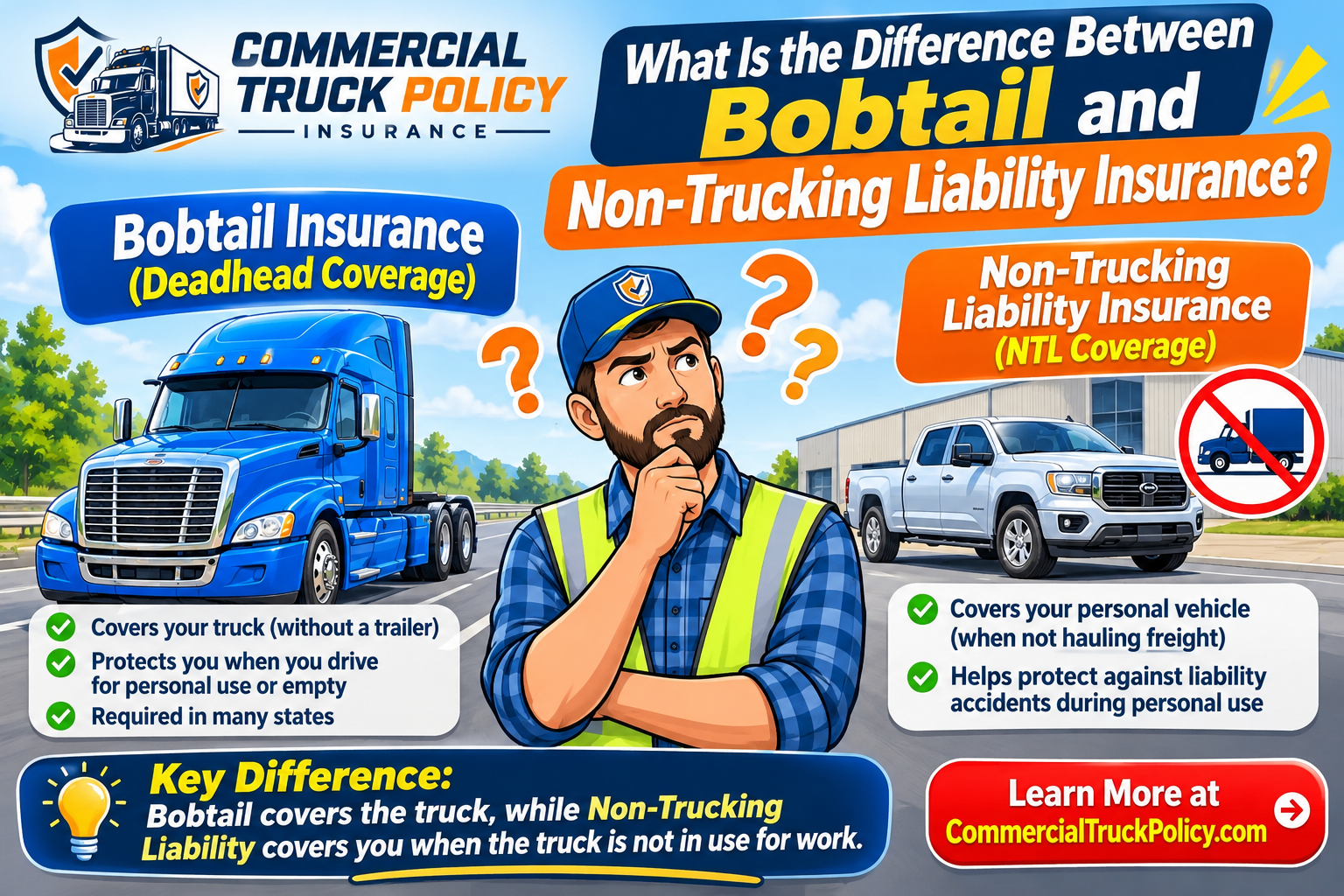
For independent owner-operators leased onto a primary motor carrier, managing commercial insurance can quickly become confusing. When your rig is under active dispatch, your leasing carrier’s Primary Auto Liability Insurance protects you on the highway.
However, the moment you unhook your trailer or finish your shift, a major coverage gap opens: Who pays if you get into a highway accident when you are not hauling freight under active dispatch?
This is where Bobtail Insurance and Non-Trucking Liability (NTL) come in. While many truckers use these terms interchangeably, they are two distinct policies with completely different triggers. Relying on the wrong policy can leave you completely unprotected after a serious crash, resulting in denied claims and severe out-of-pocket financial loss.
Here is a practical breakdown of the differences between Bobtail and NTL insurance, how they operate in real-world scenarios, and how to determine which policy your lease contract requires in 2026.
Quick Comparison: Bobtail vs. Non-Trucking Liability (NTL)
The fundamental difference comes down to Equipment Configuration (whether a trailer is attached) versus Trip Intent (whether you are driving for business or personal reasons):
| Feature | Bobtail Insurance | Non-Trucking Liability (NTL) |
| Primary Trigger | Operating a tractor without a trailer attached | Operating a tractor for strictly personal, non-business use |
| Trailer Status | Must be unhooked (Power unit only) | Trailer can be attached (empty) or unhooked |
| Business / Dispatch Status | Covers trips without a trailer, whether under dispatch or off-dispatch (per policy terms) | Strictly excludes any business use, dispatch, or revenue-generating trips |
| Primary Beneficiary | Leased owner-operators moving between yards or loads | Leased owner-operators driving for personal errands |
| Third-Party Coverage | Bodily injury & property damage to others | Bodily injury & property damage to others |
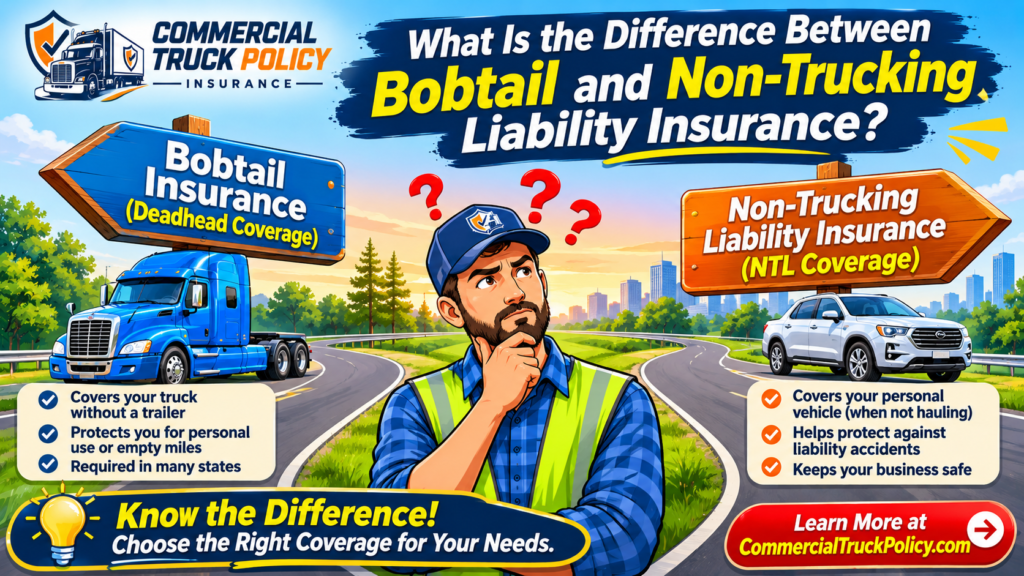
1. What Is Bobtail Insurance?
“Bobtailing” is the trucking industry term for driving a semi-tractor without a trailer attached behind it. Bobtail Insurance is specialized primary liability coverage that protects you when operating your power unit without a trailer, regardless of whether you are actively under dispatch or traveling between terminal locations.
Real-World Bobtail Scenarios
- Scenario A: You drop off a loaded dry van trailer at a terminal in Atlanta and drive your bobtail tractor 50 miles to pick up another trailer in Macon under dispatch.
- Scenario B: You drop a load at a customer dock and drive your power unit without a trailer to a local truck stop to rest for the night.
If an accident occurs during these trips, Bobtail Insurance responds to pay for third-party bodily injury and property damage because the tractor was operated without a trailer attached.
Key Distinction: Bobtail insurance is defined by the physical shape of your rig (no trailer attached). It focuses on equipment setup rather than whether you are on a personal errand or driving for business.
2. What Is Non-Trucking Liability (NTL) Insurance?
Non-Trucking Liability (NTL) provides liability protection for leased owner-operators when operating their commercial truck for strictly personal, non-business purposes.
Under federal Truth-in-Leasing regulations (49 CFR Part 376), when you lease your truck to an authorized motor carrier, their primary liability insurance covers you during business operations. However, the moment you use your truck for personal reasons outside of dispatch, the carrier’s insurance stops applying. NTL steps in to fill that personal gap. (You can review federal leasing and insurance responsibilities via the FMCSA Lease and Interchange of Vehicles Regulations portal.)
Real-World NTL Scenarios
- Scenario A: You drive your semi-truck (with or without an empty trailer) to a local grocery store or doctor’s appointment on your day off.
- Scenario B: You take your tractor to a local service shop for routine personal maintenance during your home time, completely off-dispatch.
If a collision occurs during these personal trips, Non-Trucking Liability pays for third-party injuries and property damage.
The Business Exclusion Warning: The moment you haul freight, drive toward a load pick-up, wash your truck to prepare for a dispatched trip, or perform any activity that generates revenue for your business, NTL coverage immediately voids. If an accident occurs while performing a business task, NTL will deny the claim.
3. Real-World Claim Scenarios: How Insurers Evaluate an Accident
To see exactly how an insurance claims adjuster determines which policy pays, compare these two common situations:
Case 1: Bobtailing to a Pick-Up (Under Dispatch)
- Trip Status: Tractor only (no trailer), traveling to pick up a load for your motor carrier.
- Bobtail Policy: COVERED. The tractor was operated without a trailer attached.
- NTL Policy: DENIED. Traveling to pick up a load is a business activity, which NTL strictly excludes.
Case 2: Driving to a Grocery Store with an Empty Trailer (Off-Dispatch)
- Trip Status: Tractor with an empty trailer attached, running a personal errand on a Sunday off.
- Bobtail Policy: DENIED. A trailer was attached to the fifth wheel.
- NTL Policy: COVERED. The trip was strictly personal and completely off-dispatch.
4. Do You Need Bobtail or Non-Trucking Liability?
The policy you need depends entirely on your operational setup and your lease agreement with your motor carrier:
You Need Non-Trucking Liability (NTL) If:
- You are an owner-operator leased onto a motor carrier that provides your primary auto liability insurance while under dispatch.
- Your lease agreement explicitly mandates NTL coverage to protect against personal-use accidents during off-duty home time.
You Need Bobtail Insurance If:
- You frequently haul power-only loads where you drop trailers and drive significant distances with just the power unit.
- Your primary carrier’s insurance agreement specifically excludes coverage during non-freight bobtail movements between yards.
What If You Have Your Own MC Authority?
If you operate under your own independent MC/USDOT authority, you generally do not need Bobtail or NTL insurance. Your continuous Primary Auto Liability Policy ($1,000,000 limit) covers your tractor 24/7, whether you are pulling a loaded trailer, hauling an empty trailer, bobtailing, or driving for personal errands.
Summary Checklist for Truckers
| Coverage Option | Best Suited For | Key Exclusion |
| Bobtail Insurance | Drivers frequently operating a power unit without a trailer | Does not apply if any trailer (loaded or empty) is attached |
| Non-Trucking Liability (NTL) | Leased owner-operators using their rig for personal errands | Strict exclusion of any business activity or active dispatch |
| Primary Auto Liability | Independent MC authority holders | Mandatory $1M standard limit; requires separate Physical Damage for your own rig |
Frequently Asked Questions (FAQs)
1. Does Bobtail or NTL insurance cover damage to my own truck? No. Both Bobtail and NTL are strictly third-party liability coverages (paying for damage or injuries you cause to other people). To cover physical repairs to your own tractor after a crash, fire, or theft, you must purchase a separate Physical Damage (Collision & Comprehensive) policy.
2. How much does Non-Trucking Liability (NTL) cost? NTL is relatively affordable compared to primary commercial liability. For a single power unit, NTL coverage typically costs between $25 and $50 per month ($300 to $600 annually), depending on your driving record and coverage limits.
3. Can I haul an empty trailer under Bobtail insurance? No. Bobtail insurance strictly requires the tractor to be operating without any trailer attached. Pulling an empty trailer is known as “deadheading”—not bobtailing—and is excluded under standard bobtail policies.
4. Do I need NTL if I park my semi-truck at a secure yard and drive my personal car home? If your commercial tractor never moves unless it is under active dispatch for your motor carrier, you rarely trigger personal-use exposure. However, most motor carriers still contractually require leased owner-operators to carry NTL on file before onboarding.
Editorial & Regulatory Disclaimer
This guide is researched and published for educational and informational purposes only and does not constitute legal, financial, or licensed insurance advice. Policy definitions, exclusions, and lease requirements vary by insurance carrier and motor carrier contract. Always review your lease agreement and consult a licensed commercial transportation insurance agent before binding coverage.