
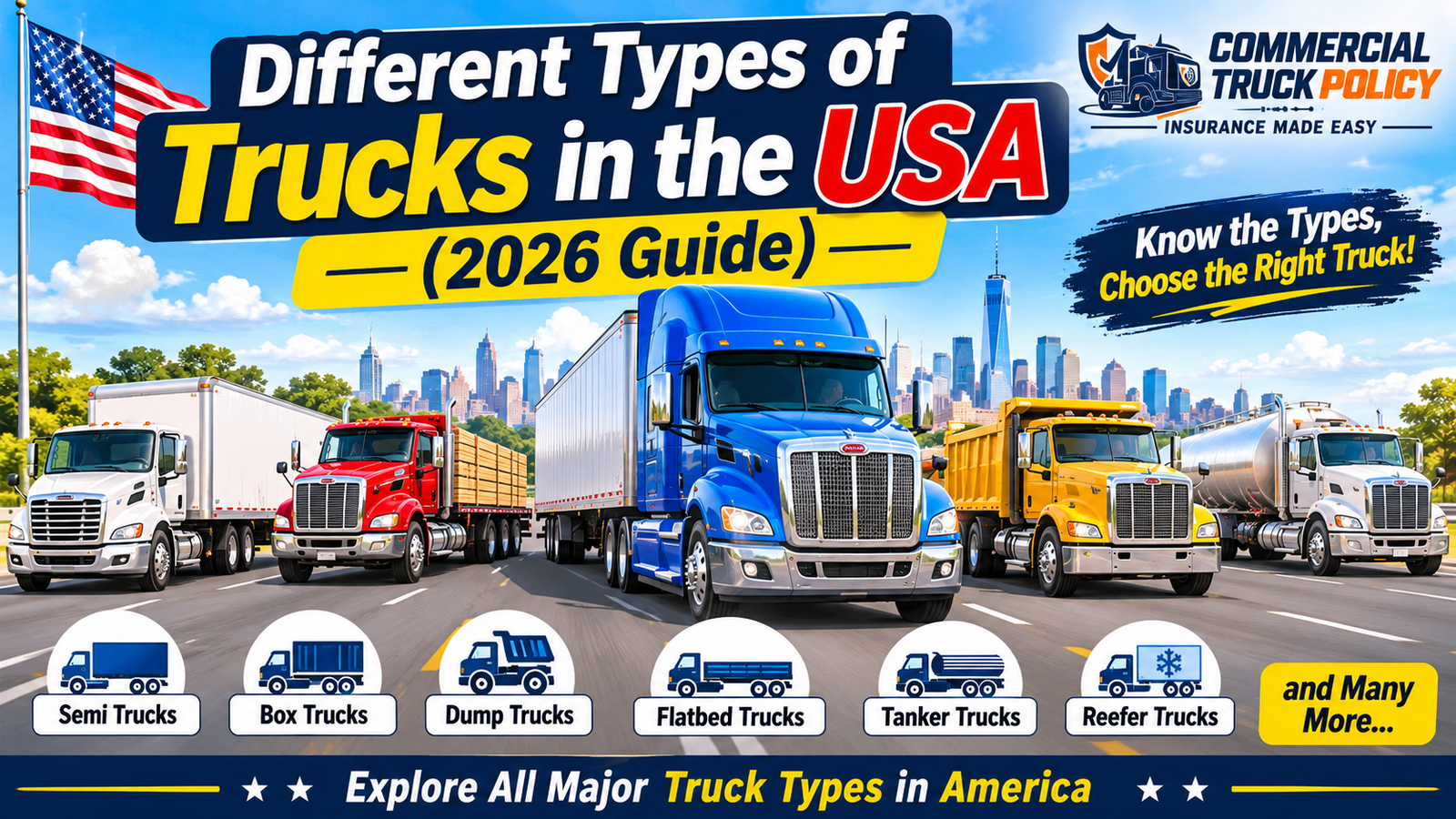
The American supply chain depends on millions of commercial trucks moving everything from fresh produce and retail goods to raw steel and heavy machinery. However, stepping onto any U.S. highway or construction site makes one thing immediately clear: no single truck is built to do every job.
Choosing the wrong truck configuration does not just hurt your fuel economy and payload capacity—it directly impacts whether you need a Commercial Driver’s License (CDL), how much you pay in commercial truck insurance, and which freight brokers will work with you.
Whether you are an aspiring owner-operator buying your first rig, a fleet manager expanding operations, or researching the American transportation industry, here is a practical breakdown of the 15 most common types of commercial trucks in the USA, their real-world applications, and the specific insurance requirements behind each one.
Quick Overview: 15 Commercial Truck Types at a Glance
| # | Truck Type | Primary Freight / Purpose | Typical GVWR Class | Key Insurance Priority |
| 1 | Semi-Truck (Tractor-Trailer) | Long-haul interstate freight | Class 8 (33,001+ lbs) | $1M Primary Liability + $100k Cargo |
| 2 | Box Truck (Straight Truck) | Local delivery & moving | Class 4–7 (14,001–33,000 lbs) | Primary Liability + Physical Damage |
| 3 | Flatbed Truck | Construction & oversized freight | Class 7–8 | Cargo with Tarp/Securement terms |
| 4 | Dump Truck | Loose aggregates (gravel, sand) | Class 7–8 | Auto Liability + Off-Road/Site coverage |
| 5 | Tanker Truck | Bulk liquids, fuel & chemicals | Class 8 | High Liability ($1M–$5M) + Pollution |
| 6 | Refrigerated (Reefer) Truck | Temperature-sensitive goods | Class 6–8 | Cargo + Reefer Breakdown rider |
| 7 | Tow Truck | Vehicle recovery & roadside | Class 3–8 | On-Hook & Garagekeepers Liability |
| 8 | Pickup Truck (Hotshot) | Light commercial & hotshot loads | Class 2b–3 (8,501–14,000 lbs) | Commercial Auto (Not Personal Auto) |
| 9 | Garbage Truck | Municipal & commercial waste | Class 8 | Heavy Auto Liability + Compactor cover |
| 10 | Car Carrier (Auto Hauler) | Multi-vehicle transport | Class 7–8 | Specialized Auto Hauler Cargo |
| 11 | Logging Truck | Raw timber & forestry | Class 8 | High-risk Rural/Off-Road Liability |
| 12 | Cement Mixer Truck | Ready-mix concrete delivery | Class 8 | Specialized Drum/Equipment coverage |
| 13 | Step Van | Parcel & last-mile courier | Class 3–5 | Multi-stop Commercial Auto + Cargo |
| 14 | Heavy Haul Truck | Oversized industrial equipment | Class 8+ (Multi-axle) | High-Limit Cargo + Permit compliance |
| 15 | Livestock Truck | Farm animals & cattle | Class 8 | Specialized Live Animal Cargo |
Detailed Breakdown: 15 Commercial Trucks & Their Insurance Requirements
1. Semi-Trucks (Tractor-Trailers)
When people picture American trucking, they picture an 18-wheeler. A semi-truck consists of two distinct units: the power unit (tractor) that houses the engine and sleeper cab, and a detachable semi-trailer (such as a 53-foot dry van). Because the trailer detaches, carriers can drop loaded trailers at warehouses and immediately hook onto empty ones.
- Best For: Long-haul Over-the-Road (OTR) interstate freight, retail distribution, and palletized goods.
- Insurance Reality: Operating interstate over 10,000 lbs GVWR triggers mandatory FMCSA financial responsibility filings (Form BMC-91X under 49 CFR § 387.9). While the federal minimum for general freight is $750,000, freight brokers universally require $1,000,000 in Primary Auto Liability and $100,000 in Motor Truck Cargo.
2. Box Trucks (Straight Trucks)
Unlike a tractor-trailer, a box truck is built on a single, unified frame where the cab and the enclosed rectangular cargo box share the same chassis. Most range from 16 to 26 feet in length. Because many 26-foot box trucks sit right at 26,000 lbs GVWR, drivers can often operate them legally without a Class A or Class B CDL.
- Best For: Final-mile retail deliveries, furniture moving, appliance hauling, and regional courier routes.
- Insurance Reality: New box truck authorities face steep first-year premiums (often $12,000–$16,000/year) because underwriters view non-CDL urban delivery drivers as higher-frequency collision risks.
3. Flatbed Trucks
Flatbed trucks feature a completely open, level deck with no roof or side walls. This open architecture allows cranes and forklifts to load heavy, irregularly shaped freight from the sides or overhead. Drivers must master manual load securement using heavy-duty chains, binders, straps, and tarps.
- Best For: Structural steel, lumber, bricks, roofing materials, and mid-sized industrial machinery.
- Insurance Reality: Insurers scrutinize flatbed cargo claims closely. If rain ruins a load of drywall because the driver failed to secure tarps properly, standard cargo policies may deny the claim for negligence.
4. Dump Trucks
Built for rugged off-road and construction environments, dump trucks feature an open-top steel bed mounted on a heavy hydraulic piston that tilts upward to dump loose materials out the rear gate. Common variations include standard single-axle dumps, tri-axle dumps, and articulated off-road haulers.
- Best For: Hauling gravel, sand, asphalt, topsoil, and demolition debris.
- Insurance Reality: Because dump trucks frequently leave paved highways to enter active construction zones, policies must explicitly cover off-road and job-site operations alongside standard road liability.
5. Tanker Trucks
Tanker trucks carry cylindrical pressurized or non-pressurized vessels designed to haul liquids, liquefied gases, or dry bulk powders (like cement or flour). Driving a tanker requires a Tanker Endorsement (N) on a CDL due to the “liquid surge” effect, where shifting liquid weight can push a truck through an intersection or cause rollovers on curves.
- Best For: Gasoline, diesel, crude oil, industrial chemicals, milk, and potable water.
- Insurance Reality: Hauling non-hazardous liquids (like milk) requires standard $1M liability. However, hauling flammable fuels or hazardous materials requires $1,000,000 to $5,000,000 in liability, an MCS-90 Endorsement, and Pollution Liability coverage.
6. Refrigerated Trucks (Reefer Trucks)
A reefer truck looks like a standard dry van or box truck from the outside, except it features thick foam insulation and an independent diesel-powered refrigeration unit (such as Thermo King or Carrier) mounted on the front nose to keep cargo between -20°F and +70°F.
- Best For: Fresh produce, frozen meats, dairy, seafood, flowers, and temperature-sensitive pharmaceuticals.
- Insurance Reality: Standard Motor Truck Cargo insurance does not cover spoiled food if your cooling unit breaks down mechanically. Reefers must purchase a specific Reefer Breakdown Endorsement and maintain strict temperature and maintenance logs.
7. Tow Trucks (Wreckers & Rollbacks)
Tow trucks are specialized recovery vehicles equipped with hydraulic flatbeds (rollbacks), wheel-lifts, or heavy-duty rotating booms designed to rescue disabled, wrecked, or illegally parked vehicles.
- Best For: Roadside assistance, municipal police impounds, accident recovery, and heavy semi-truck towing.
- Insurance Reality: Standard auto liability only protects your tow truck—it does not pay if you accidentally drop or damage a customer’s car while towing it. Tow operators must carry On-Hook Towing Insurance and Garagekeepers Legal Liability if storing vehicles in a lot.
8. Pickup Trucks (Commercial & Hotshot)
Heavy-duty 3/4-ton and 1-ton pickup trucks (like the Ford F-350, Ram 3500, or Chevy Silverado 3500 dually) serve as the workhorses of American contractors and Hotshot Trucking—where drivers pull 40-foot gooseneck flatbed trailers to haul time-sensitive freight without owning a Class 8 semi.
- Best For: Construction contractors, landscapers, mobile mechanics, and interstate hotshot freight.
- Insurance Reality: Using a personal auto insurance policy for a pickup truck used in business or hotshot hauling is an instant ground for claim denial. Commercial use requires a Commercial Auto Policy (and a $1M MC authority policy if hauling interstate freight for hire).
9. Garbage & Refuse Trucks
Garbage trucks are heavy vocational vehicles built with hydraulic compactors and automated side-arm or front-loading forks to lift dumpsters and residential bins, compressing waste inside the body.
- Best For: Municipal sanitation, residential trash routes, and commercial recycling collection.
- Insurance Reality: Because garbage trucks make hundreds of stops daily in tight residential neighborhoods with heavy pedestrian traffic, underwriters price them based on high low-speed backing and property damage exposure.
10. Car Carrier Trucks (Auto Haulers)
Car carriers use specialized multi-level open or enclosed skeletal trailers equipped with hydraulic ramps and wheel-strap systems to transport anywhere from 3 to 9 passenger vehicles simultaneously.
- Best For: Dealership inventory transfers, auto auctions (Copart/Manheim), snowbird vehicle relocation, and exotic car transport.
- Insurance Reality: Auto haulers require specialized Auto Hauler Cargo Coverage with high limits ($250,000+) and explicit loading/unloading coverage, as most damage (scratches, bumper scrapes) occurs while driving vehicles up and down the ramps.
11. Logging Trucks
Logging trucks are heavy-duty tractors paired with open-frame bolster trailers fitted with tall vertical steel stakes designed to cradle freshly cut raw timber from forest logging sites to lumber mills.
- Best For: Forestry, timber harvesting, and sawmill supply.
- Insurance Reality: Operating on steep, unpaved mountain logging roads with high-center-of-gravity loads places logging trucks in a high-risk underwriting tier, requiring specialized forestry commercial insurers.
12. Cement Mixer Trucks
Cement mixers carry a large, angled rotating drum powered by the truck’s engine. The drum spins continuously during transit to agitate wet concrete, preventing it from hardening before reaching the job site.
- Best For: Residential foundations, commercial high-rises, bridges, and highway paving projects.
- Insurance Reality: Timing is critical—if a mixer breaks down in traffic and concrete hardens inside the drum, chiseling it out costs thousands. Policies must account for both heavy chassis physical damage and specialized mixer drum equipment.
13. Step Vans (Multi-Stop Delivery Vans)
Step vans (such as UPS or FedEx delivery trucks) feature a boxy aluminum body, sliding side doors, direct cab-to-cargo walk-through access, and a low step-in height engineered so drivers can exit and enter dozens of times an hour without joint strain.
- Best For: Last-mile parcel delivery (Amazon DSPs, FedEx Ground), uniform services, and bakery/food distribution.
- Insurance Reality: Fleet policies for step vans focus heavily on high-frequency minor fender-benders, backing collisions, and commercial package cargo protection.
14. Heavy Haul Trucks (Oversize / Overweight)
When cargo exceeds standard legal highway dimensions (8.5 ft wide, 13.5 ft tall, or 80,000 lbs gross weight), heavy haulers deploy high-horsepower tractors with multi-axle Lowboy or RGN (Removable Gooseneck) trailers to distribute extreme weight across the pavement.
- Best For: Bulldozers, excavators, wind turbine blades, power transformers, and prefabricated bridge sections.
- Insurance Reality: Heavy haul policies require high cargo limits ($250,000 to $1,000,000+), strict adherence to state oversize route permits, and escort vehicle coordination.
15. Livestock Trucks (Bull Haulers)
Livestock trailers (commonly called “bull racks”) feature punched aluminum sides for continuous airflow, non-slip cleated flooring, and internal multi-deck gates designed to safely transport live animals across long distances without overheating.
- Best For: Cattle, hogs, sheep, and poultry transport between ranches, feedlots, and processing plants.
- Insurance Reality: Standard cargo insurance excludes live animals. Livestock carriers must buy specialized Livestock Transit Coverage that addresses animal mortality, suffocation, or injury following a rollover or crash.
(Regulatory Reference: Federal vehicle weight classes and interstate commercial thresholds are governed by the Federal Highway Administration (FHWA) Vehicle Weight Regulations and FMCSA Insurance Requirements.)
4 Essential Steps Before Buying a Commercial Truck
If you are planning to purchase a commercial vehicle for your business in 2026, run through this practical checklist before signing a bill of sale:
- Verify CDL & Weight Thresholds: Any vehicle or combination with a GVWR of 26,001 lbs or more requires a Class A or Class B CDL. Crossing state lines for commerce in any vehicle over 10,001 lbs GVWR requires a USDOT number and FMCSA compliance.
- Match Equipment to Freight Contracts: Do not buy a dry van if your primary local contacts need flatbed steel hauling. Verify load availability and freight rates in your home zip code first.
- Quote Insurance Before Buying the Truck: Commercial truck insurance varies wildly by truck class, driver CDL tenure, and cargo type. Always get a binding insurance quote using the truck’s VIN before finalizing financing.
- Budget for Fuel & Maintenance Reserves: A Class 8 semi averages 6 to 7.5 MPG and requires roughly $15,000–$20,000 annually in preventive maintenance, tires, and oil changes.
Frequently Asked Questions (FAQs)
1. Which commercial truck is best for starting a small business? For beginners without a Class A CDL, a 26-foot Box Truck (under 26,000 lbs GVWR) or a 1-ton Pickup Truck is the most accessible starting point. They have lower purchase prices, easier urban maneuverability, and simpler licensing requirements than Class 8 semi-trucks.
2. Can I insure a commercial truck under my personal auto policy? No. Personal auto policies strictly exclude commercial business operations, hauling goods for hire, and heavy GVWR vehicles. If an accident occurs while working, the insurer will deny the claim and cancel your policy.
3. What is the most common commercial truck in the United States? The Class 8 Semi-Truck (Tractor-Trailer) is the backbone of U.S. freight transportation, moving roughly 70% of all domestic tonnage across interstate highways.
4. Do I need an MC Number for every type of commercial truck? No. You only need an MC Number (Operating Authority) in addition to a USDOT Number if you transport regulated commodities for hire across state lines. Local intrastate operators or private carriers hauling their own company goods typically only need a USDOT Number and state permits.
Editorial & Regulatory Disclaimer
This guide is researched and published for educational and informational purposes only and does not constitute legal, regulatory, or licensed insurance advice. Commercial vehicle weight laws, CDL rules, and FMCSA insurance requirements vary by state and commodity. Always consult a licensed commercial transportation insurance agent before purchasing equipment or binding coverage.