
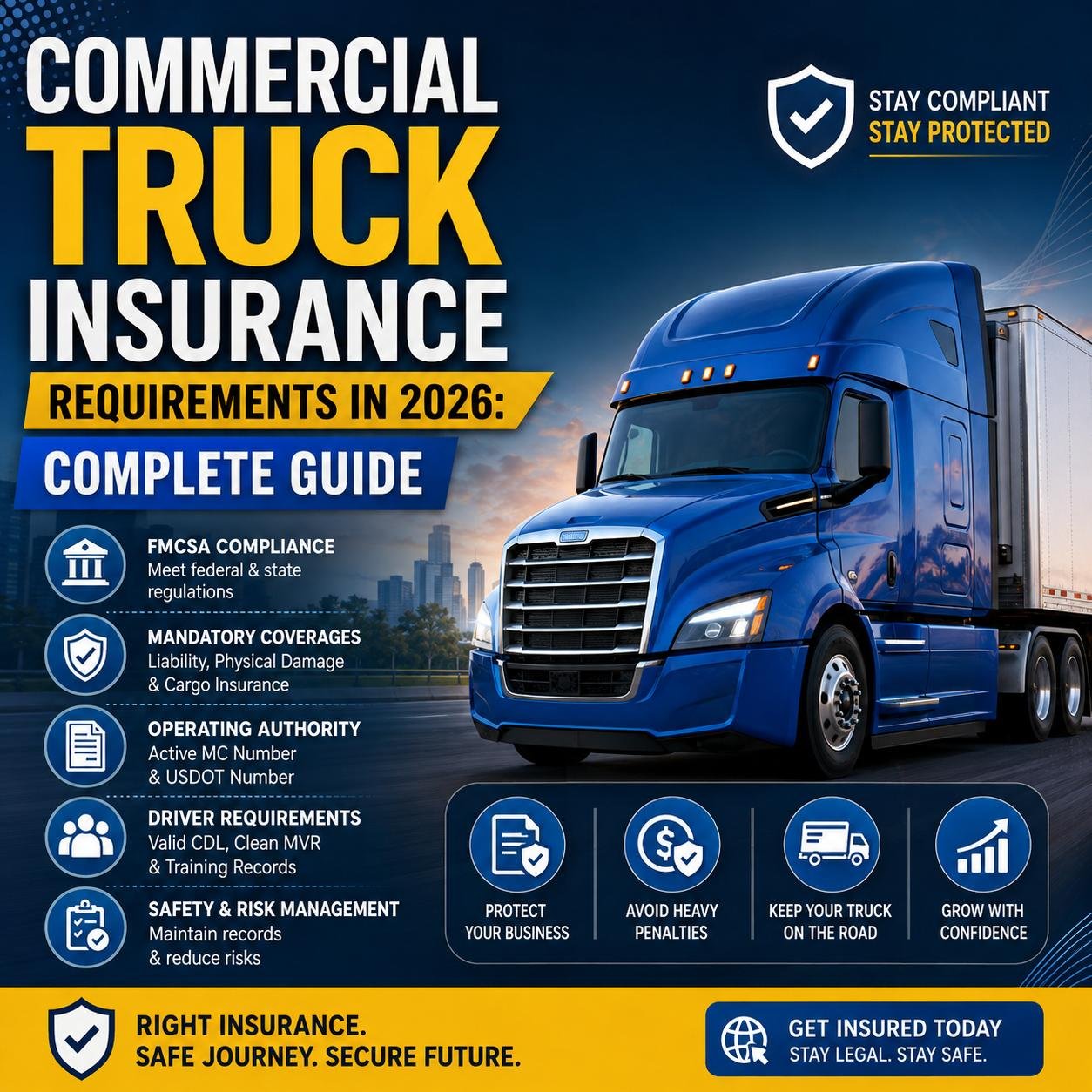
FMCSA Insurance Requirements 2026: Complete Guide for Trucking Companies
Whether you are launching a new motor carrier authority or managing an established commercial fleet, staying compliant with the Federal Motor Carrier Safety Administration (FMCSA) insurance mandates is vital to keeping your trucks on the road.
For new trucking entrepreneurs, navigating commercial auto insurance can be overwhelming. How much public liability insurance does federal law actually require? Why do freight brokers ask for $1,000,000 when the FMCSA minimum is $750,000? What paperwork do you need to submit to secure an accurate insurance quote?
Here is an updated guide to the FMCSA insurance requirements for 2026, the exact documents required for policy underwriting, and how to structure your insurance program to satisfy both federal auditors and freight brokers.
What Is the FMCSA & What Does It Regulate?
The FMCSA is the federal agency within the U.S. Department of Transportation (USDOT) that regulates commercial motor vehicles operating in interstate commerce.
Under 49 CFR Part 387, the FMCSA mandates that all regulated motor carriers demonstrate financial responsibility by maintaining minimum levels of Public Liability Insurance (Bodily Injury and Property Damage – BIPD). This ensures that if a commercial rig causes a highway accident, injured third parties and property owners are financially protected.
ℹ️ 2026 System Update: The FMCSA is transitioning its legacy Licensing & Insurance (L&I) database to the new Motus online portal. During this transition, insurance carriers continue to submit electronic filings (Forms BMC-91 and BMC-91X) on behalf of motor carriers to verify active financial responsibility.
FMCSA Federal Insurance Minimums in 2026
The required financial responsibility limit depends on the vehicle’s Gross Vehicle Weight Rating (GVWR), the type of commodity hauled, and whether you operate for-hire or private transportation:
| Carrier Classification | Cargo & Operation Type | Federal Minimum BIPD Limit |
| For-Hire Freight (GVWR $\ge$ 10,001 lbs) | Non-Hazardous General Property | $750,000 |
| For-Hire & Private (Hazmat) | Oil, Certain Hazardous Materials | $1,000,000 |
| Specialized Hazmat | Explosives, Poison Gas, Radioactive Freight | $5,000,000 |
| Household Goods (HHG) Movers | Interstate Residential/Commercial Moving | $750,000 Liability + $5,000/vehicle Cargo |
| For-Hire Freight (GVWR < 10,001 lbs) | Non-Hazardous Freight (Small Vans/Pickups) | $300,000 |
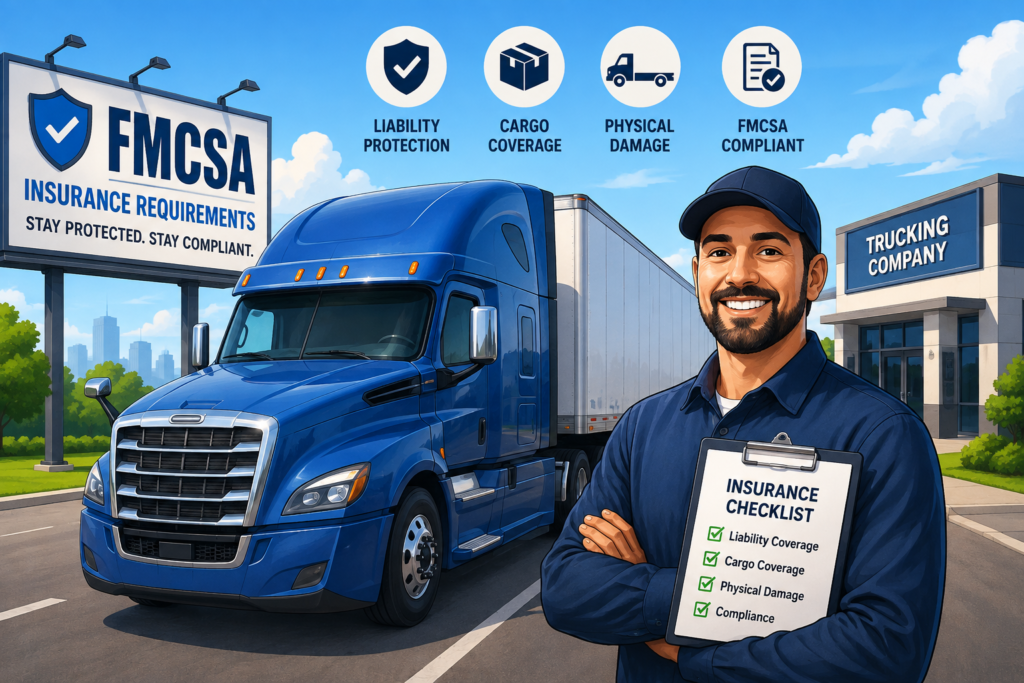
Federal Minimums vs. Broker Contract Requirements
A common trap for new owner-operators is purchasing an insurance policy that only meets the FMCSA $750,000 federal minimum.
While a $750,000 policy satisfies federal law for general freight, over 90% of freight brokers, shippers, and load boards mandate higher limits before issuing a rate confirmation:
- Primary Auto Liability: Brokers standardly mandate $1,000,000 in Primary Auto Liability regardless of the federal $750,000 minimum.
- Motor Truck Cargo Insurance: While federal law only mandates cargo insurance for Household Goods (HHG) movers, freight brokers contractually require a $100,000 Motor Truck Cargo policy.
- General Liability: Shippers and warehouse terminals often require $1,000,000 in Commercial General Liability (CGL) to cover non-driving incidents on their property.
Key Documents Needed for a Commercial Truck Insurance Quote
Insurance underwriters carefully evaluate risk before binding a policy. Gathering these documents ahead of time ensures faster quote turnarounds and prevents unexpected premium spikes:
1. Business Registration & FMCSA Numbers
- USDOT Number & Pending MC Docket Number: Required to locate your carrier registration profile.
- Exact Legal Business Name & EIN: Must match letter-for-letter across your state LLC/Corporation filings, FMCSA registration, and IRS tax records.
2. Driver CDL Information & Driving Records (MVR)
- CDL License Numbers & State of Issuance for all owners and hired drivers.
- Commercial Driving History: 3-to-5-year Motor Vehicle Record (MVR) verifying clear driving history, safety violations, or previous accidents.
3. Equipment Details & Vehicle Identifiers
- Tractor & Trailer VINs: Accurate 17-digit VINs for every power unit and trailer.
- Stated Values / Actual Cash Value (ACV): Purchase price or market replacement value for calculating Physical Damage coverage (Collision & Comprehensive).
4. Operating Profile Details
- Garaging / Parking Address: The physical zip code where equipment is stored overnight (rates vary significantly by geographic location).
- Target Operating Radius: Local (< 100 miles), Regional (< 500 miles), or Nationwide Over-the-Road (OTR).
- Commodity Breakdown: Exact percentage of freight types hauled (e.g., 80% Dry Van General Freight, 20% Refrigerated Produce).
5. Historical Operational Records (For Established Carriers)
- IFTA Reports: Recent International Fuel Tax Agreement quarterly reports verifying mileage driven by jurisdiction.
- 3 to 5-Year Loss Runs: Official claims history reports generated by previous insurance carriers.
Summary of Core Commercial Truck Coverages
| Coverage Type | What It Protects | Mandated By |
| Primary Auto Liability | Third-party bodily injury and property damage | FMCSA Law & Brokers |
| Motor Truck Cargo | Freight inside the trailer during transit | Shippers & Freight Brokers |
| Physical Damage | Repairs to your tractor/trailer after crash, fire, or theft | Financing Lenders & Banks |
| General Liability | Non-driving liabilities at docks or terminals | Customers & Warehouses |
| Trailer Interchange | Physical damage to non-owned trailers pulled under contract | Equipment Leasing Agreements |
Frequently Asked Questions (FAQs)
1. Do I file my insurance documents with the FMCSA myself?
No. Insurance forms (Form BMC-91 or BMC-91X) must be electronically submitted directly to the FMCSA by an authorized insurance company. You cannot manually upload policy certificates yourself.
2. How long does it take for insurance filings to reflect in the FMCSA system?
Once your insurer submits the electronic BMC-91X filing, it generally appears on the FMCSA Licensing & Insurance (L&I) database within 24 to 72 hours.
3. What happens if my insurance policy lapses or is cancelled?
If your insurance policy cancels, your insurer immediately sends an electronic notice of cancellation to the FMCSA. If replacement coverage is not filed before the 30-day notice period ends, your operating authority will be placed in Involuntary Revocation status.
Final Thoughts
Understanding FMCSA insurance rules is about more than avoiding regulatory fines—it is about structuring a business model that satisfies shippers and freight brokers while protecting your capital.
Always partner with an experienced commercial transportation broker who understands FMCSA compliance, ensures exact electronic filings, and structures your coverage limits to support your business growth.
A complete explanation of commercial truck insurance coverages