
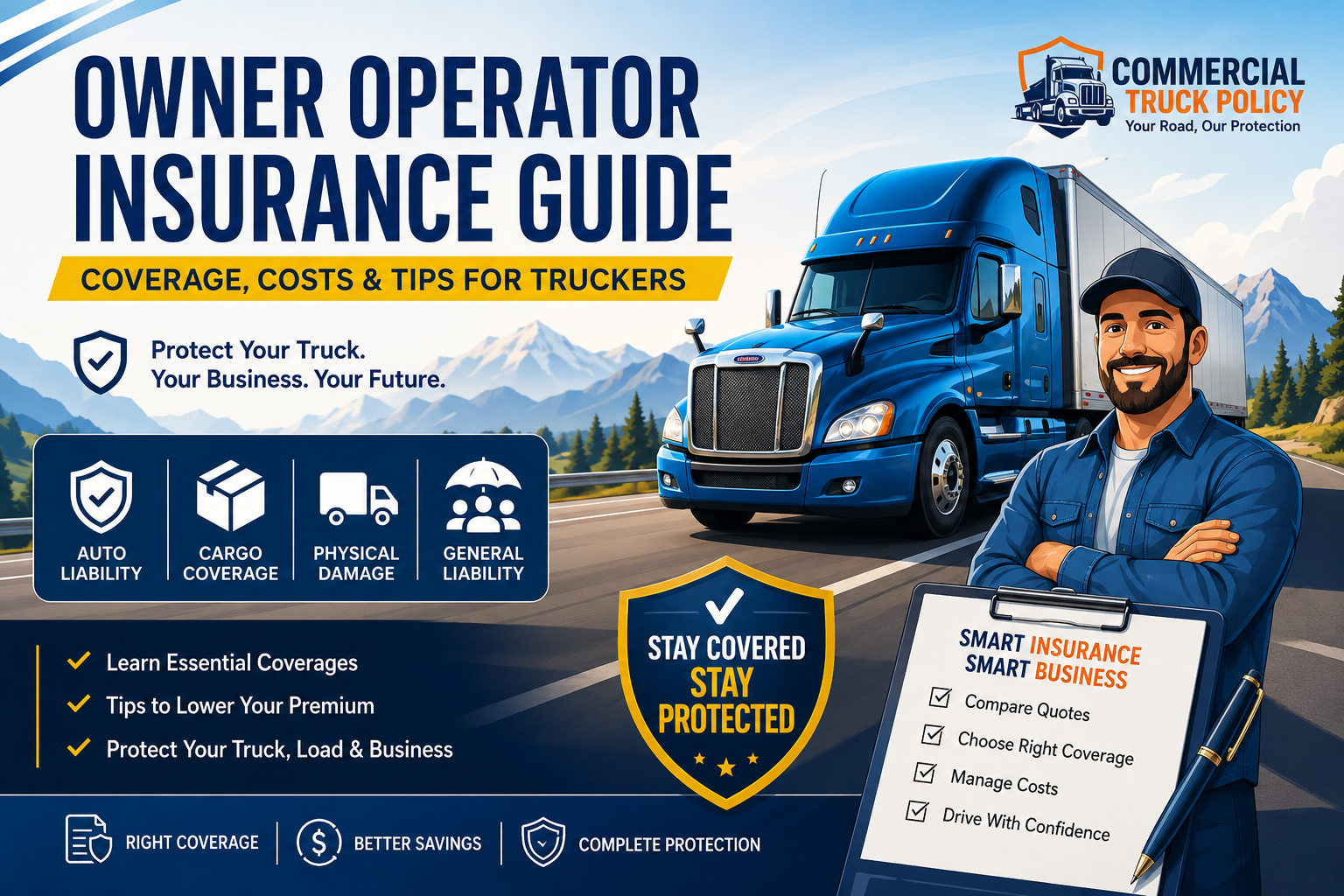
Owner Operator Insurance Guide: Coverage, Costs, and Tips for Truckers
Starting and operating a trucking business comes with significant responsibilities. An owner-operator is not only responsible for driving a commercial truck safely but also for protecting the business, equipment, cargo, and financial future of the company.
Many truckers operate under another trucking company’s authority and are added to that company’s insurance policy. In other cases, a trucker establishes their own trucking company, obtains their own operating authority, and operates their own truck. This type of independent operation is commonly associated with an owner-operator trucking business.
For independent owner-operators, having the right commercial truck insurance is one of the most important parts of running a successful trucking operation.
A properly structured insurance policy can help protect an owner-operator against financial losses resulting from accidents, cargo damage, vehicle damage, and certain liability claims.
What Is Owner Operator Insurance?
Owner-operator insurance refers to commercial trucking insurance designed for truckers who operate their own business and are responsible for their own commercial vehicle and insurance requirements.
The exact insurance requirements depend on several factors, including:
- Whether the carrier operates interstate or intrastate
- Type and weight of the vehicle
- Type of cargo being transported
- Operating authority
- States in which the truck operates
- Broker or shipper requirements
- Whether the owner-operator has additional drivers
Because every trucking operation is different, an owner-operator should select coverage based on their actual business needs rather than simply purchasing the cheapest policy available.
The Federal Motor Carrier Safety Administration (FMCSA) establishes federal financial-responsibility requirements for many interstate motor carriers. For example, for-hire interstate property carriers operating vehicles with a GVWR of 10,001 pounds or more and transporting non-hazardous property generally have a $750,000 minimum financial-responsibility requirement. Higher limits can apply to certain hazardous-material operations.
Why Is Insurance Important for Owner-Operators?
Trucking involves substantial financial risk. A single serious accident can result in damage to vehicles, cargo, property, and injuries to other people.
Insurance helps transfer some of these financial risks from the trucking business to the insurance company, subject to the policy’s terms, limits, exclusions, and deductibles.
For an owner-operator, the right insurance policy can help protect:
- The trucking company
- The commercial truck
- The trailer
- Cargo being transported
- Other people’s property
- Business finances
- Drivers and employees, depending on applicable coverage
Without appropriate coverage, an owner-operator could potentially face significant out-of-pocket expenses after an accident or covered loss.
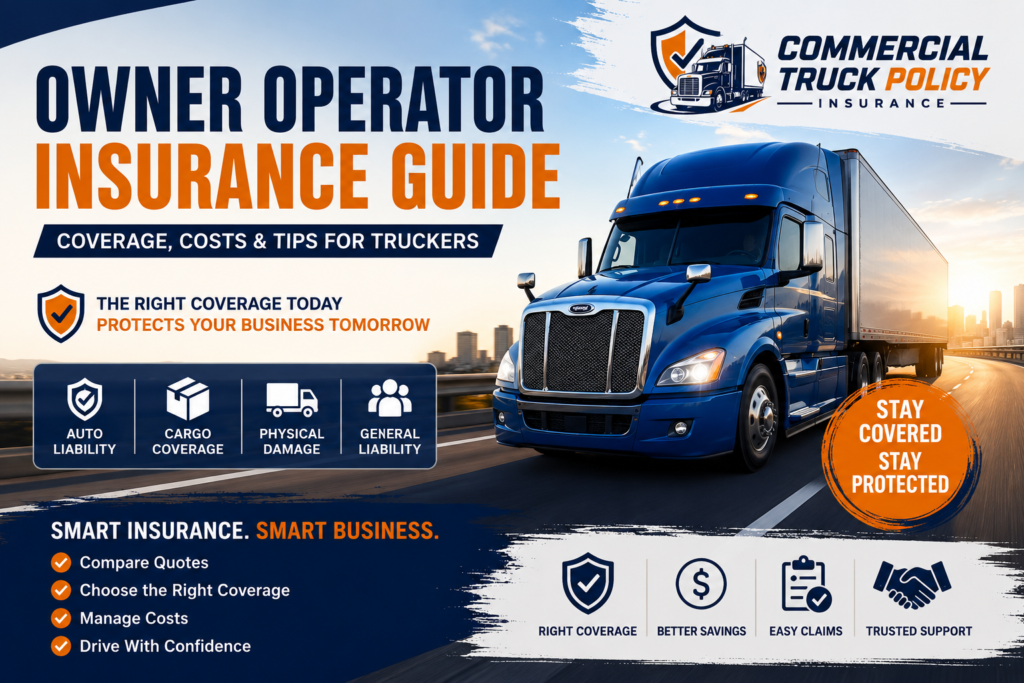
Things Owner-Operators Should Consider Before Buying Insurance
Choosing commercial truck insurance should not be based only on the lowest premium. Here are some important factors to consider.
1. Buy Coverage Based on Your Actual Needs
Every trucking company has different insurance requirements.
Before purchasing a policy, consider your:
- Type of trucking operation
- Cargo
- Truck and trailer value
- Operating radius
- Number of drivers
- States of operation
- Broker requirements
- Contract requirements
Avoid paying for coverage that your business does not need, but also avoid removing important protection simply to reduce your premium.
2. Don’t Automatically Choose the Cheapest Policy
A low premium may look attractive, but price should not be the only factor.
Before selecting a policy, review the coverage limits, deductibles, exclusions, endorsements, claims process, and financial strength of the insurer.
A policy that saves money initially may become expensive if it does not provide the protection your business actually needs.
3. Compare Multiple Insurance Quotes
Owner-operators should consider obtaining quotes from several insurance companies or working with an experienced commercial trucking insurance agent who can compare available options.
Comparing three or four quotes can help you understand:
- Premium differences
- Coverage limits
- Deductibles
- Policy exclusions
- Available endorsements
- Payment options
Don’t compare quotes based only on the final premium. Make sure you are comparing similar coverage.
4. Choose a Deductible Carefully
A higher deductible can sometimes reduce the insurance premium.
However, an owner-operator should choose a deductible they can realistically afford after an accident or covered loss.
For example, if you choose a $5,000 deductible simply to lower your premium, make sure your business can actually pay that $5,000 if a claim occurs.
5. Be Accurate About Your Operating Radius
Your operating radius and mileage can affect your commercial truck insurance premium.
A local trucking operation may have different risk characteristics from a long-haul operation.
Therefore, provide your insurance agent with accurate information about how far you actually operate. Do not intentionally provide incorrect mileage or operating-radius information just to obtain a lower premium.
6. Be Careful When Hiring Drivers
If you operate your truck with an additional driver, the driver’s experience and driving history can affect underwriting and insurance costs.
Before hiring a driver, review the driver’s qualifications and driving record and make sure the driver meets applicable federal and state requirements.
A clean driving history can be beneficial when an insurer evaluates the risk of your trucking operation.
However, the idea that hiring a driver from the same state will automatically reduce your premium is not a universal insurance rule. Rates depend on the insurer’s underwriting guidelines and the overall risk profile of the operation.
7. New Trucking Companies May Pay Higher Premiums
New trucking companies can sometimes face higher insurance premiums because they have limited operating and loss history.
Insurance companies evaluate different risk factors when determining premiums, and a new business may not have the same history as an established carrier.
As your company develops an operating history, maintains good safety practices, and demonstrates responsible risk management, your insurance options may change.
8. Consider the Financial Strength of the Insurance Company
When purchasing commercial truck insurance, consider the insurer’s financial strength, reputation, claims handling, and experience with commercial trucking.
Some truckers prefer insurers with strong financial ratings because they want confidence that the carrier has the financial capacity to handle claims.
Do not select or reject an insurance company solely because of a rating label such as “A+” or because a company is an RRG. Instead, discuss the insurer’s financial strength, policy structure, claims history, and suitability for your operation with a qualified insurance professional.
Essential Insurance Coverage for Owner-Operators
The exact coverage package depends on the trucking operation, but several types of coverage are commonly important for owner-operators.
1. Auto Liability / Primary Liability Insurance
Auto Liability, also commonly called Primary Liability, is one of the most important coverages for a commercial trucking company.
It generally provides protection for covered bodily injury and property-damage liability arising from an accident for which the insured is legally responsible, subject to the policy terms and limits.
For many interstate for-hire property carriers transporting non-hazardous freight in vehicles with a GVWR of 10,001 pounds or more, the federal minimum financial-responsibility requirement is $750,000. However, the amount required for your operation can be higher depending on the cargo, vehicle, authority, contracts, and applicable state or federal requirements.
Many brokers and shippers may also require $1,000,000 in liability coverage even when the federal minimum applicable to the carrier is lower.
Therefore, before purchasing your policy, ask your broker or shipper what liability limit they require.
Important: Don’t Assume $750,000 Is Always Enough
The federal minimum is not necessarily the same as the amount a broker will require.
For example, if a broker requires $1 million in Auto Liability, a $750,000 policy may not satisfy that broker’s requirements.
Always verify the required limit before binding your policy.
2. Motor Truck Cargo Insurance
Motor Truck Cargo Insurance is designed to provide coverage for covered loss or damage to cargo being transported by the insured, subject to the policy’s terms, conditions, exclusions, and limit.
Cargo insurance is especially important for owner-operators because the freight being transported can be worth a substantial amount of money.
A broker or shipper may require a specific cargo limit before allowing a carrier to haul a load.
Common cargo limits may include:
- $100,000
- $250,000
- Higher limits depending on the type and value of freight
A $100,000 cargo limit is common in many trucking arrangements, but requirements vary by broker, shipper, commodity, and contract.
Before purchasing your policy, confirm the cargo limit required by the brokers you plan to work with.
3. Physical Damage Insurance
Physical Damage Coverage is designed to protect the insured truck and other covered equipment against covered losses such as collision and certain other physical damage, depending on the policy.
For example, if an insured truck is involved in a covered accident and suffers damage, Physical Damage coverage may help pay for covered repairs, subject to the policy terms and deductible.
The insured value of the equipment is an important part of this coverage.
For example, if a truck is insured for $50,000 and a trailer is insured for $20,000, the total scheduled equipment value would be $70,000.
However, the amount payable for a claim is not automatically equal to the scheduled value in every situation. The actual claim payment depends on the policy terms, valuation method, deductible, and circumstances of the loss.
4. General Liability
General Liability Insurance can provide protection for certain third-party bodily injury and property-damage claims that are not covered under the commercial auto liability policy.
Whether an owner-operator needs General Liability depends on the nature of the operation and contractual requirements.
Some brokers, shippers, warehouses, or customers may require General Liability coverage before doing business with a carrier.
Therefore, check your broker and customer requirements before deciding whether this coverage is necessary for your business.
A Practical Approach for a New Trucking Company
One common mistake new trucking companies make is choosing insurance without first understanding the requirements of the brokers they intend to work with.
Instead of choosing a policy based on a general rule such as “always buy $750,000” or “always buy $1 million,” first determine:
- What type of freight you will haul
- Where you will operate
- Whether you operate interstate or intrastate
- What liability limit your brokers require
- What cargo limit your brokers require
- The value of your truck and trailer
- Your expected operating radius
- Whether you will use additional drivers
For a qualifying interstate general-freight carrier, $750,000 may satisfy the federal minimum, while a broker may require $1 million. FMCSA’s current insurance filing guidance confirms that insurance requirements vary according to carrier type, cargo, vehicle type, and operating authority.
Therefore, rather than intentionally purchasing insufficient coverage and planning to increase it later, work with your insurance agent and broker to determine the appropriate coverage from the beginning.
Does Insurance Help Establish a Company’s Operating History?
A trucking company may have a DOT number or business registration before it has active operating authority. Simply forming a company or obtaining a USDOT number does not automatically mean the carrier has an active operating authority.
For carriers that require FMCSA operating authority, the required insurance filing is part of the process of obtaining and maintaining that authority. FMCSA states that operating authority will not be granted until the required minimum financial responsibility is on file, and carriers must maintain the required filings to avoid revocation proceedings.
This means new carriers should understand the difference between:
- Forming a trucking business
- Obtaining a USDOT number
- Obtaining operating authority
- Filing the required insurance
- Actually operating under active authority
A carrier should never assume that simply purchasing insurance automatically makes every part of its authority or business status active.
Final Thoughts for Owner-Operators
Commercial trucking is a business with significant financial and operational risks. Insurance should therefore be treated as an important part of your business plan rather than simply another expense.
Before buying owner-operator insurance, compare multiple quotes, understand your broker’s requirements, select appropriate deductibles, accurately report your operation, and review the policy carefully.
For many owner-operators, the key coverages to evaluate include:
- Auto Liability / Primary Liability
- Motor Truck Cargo
- Physical Damage
- General Liability, when required or appropriate
Most importantly, do not purchase a policy solely because it has the lowest premium. The right policy should balance coverage, cost, insurer quality, and the actual needs of your trucking business.
Insurance requirements can vary significantly by operation, cargo, vehicle, state, and authority. Always verify current federal, state, broker, and contractual requirements with the appropriate regulatory agency, broker, or licensed insurance professional before purchasing coverage.
Important Notice
This article is provided for general educational and informational purposes only. It is not legal, insurance, financial, or regulatory advice. Federal and state requirements can change, and individual trucking operations may have different insurance obligations. Always verify current requirements with FMCSA, the applicable state authorities, your broker, and a licensed commercial trucking insurance professional.
Costly Commercial Truck Insurance Mistakes Every Trucker Should Avoid
What Is Commercial Truck Insurance Coverage? A Complete Guide for Truckers