
Starting a commercial trucking company involves several moving parts—setting up an LLC, registering for USDOT and operating authority credentials, acquiring equipment, and securing commercial insurance.
If you are applying for interstate motor carrier authority, you will quickly run into a classic chicken-and-egg question: Can I get commercial truck insurance before my operating authority is approved, or do I have to wait until my authority is active?
The short answer is yes, you can—and actually must—arrange truck insurance before your authority becomes active. In fact, binding a policy and having your insurer electronically file proof of financial responsibility with the Federal Motor Carrier Safety Administration (FMCSA) is a mandatory requirement to activate your operating authority.
Here is a practical breakdown of how the sequence works in 2026, why waiting can stall your launch, and what steps you need to follow.
Quick Summary: Operating Authority & Insurance Sequence
| Order | Stage | Key Requirement | Who Completes It? |
| 1 | Submit FMCSA Application | Apply for USDOT registration and for-hire operating authority | Motor Carrier Owner / Applicant |
| 2 | Receive Pending Docket / Status | Application enters pending vetting and review status | FMCSA Registration System |
| 3 | Purchase Commercial Insurance | Obtain quotes, pay down payment, and bind policy | Carrier Owner & Transportation Agent |
| 4 | Electronic Insurance Filing | Insurer submits Form BMC-91 or BMC-91X electronically | Authorized Insurance Filer |
| 5 | Complete Process Agent Filing | File Form BOC-3 designating process agents by state | Blanket Process Agent Service |
| 6 | Authority Activation | Filings clear federal review and public protest period | FMCSA Licensing & Insurance (L&I) |
1. The Actual Sequence: How Authority and Insurance Fit Together
New owner-operators often confuse receiving a registration or docket number with holding Active Operating Authority.
When you submit your registration application with the FMCSA, your operating authority remains in “Pending” status until all mandatory financial responsibility and process agent filings are officially posted in the FMCSA system.
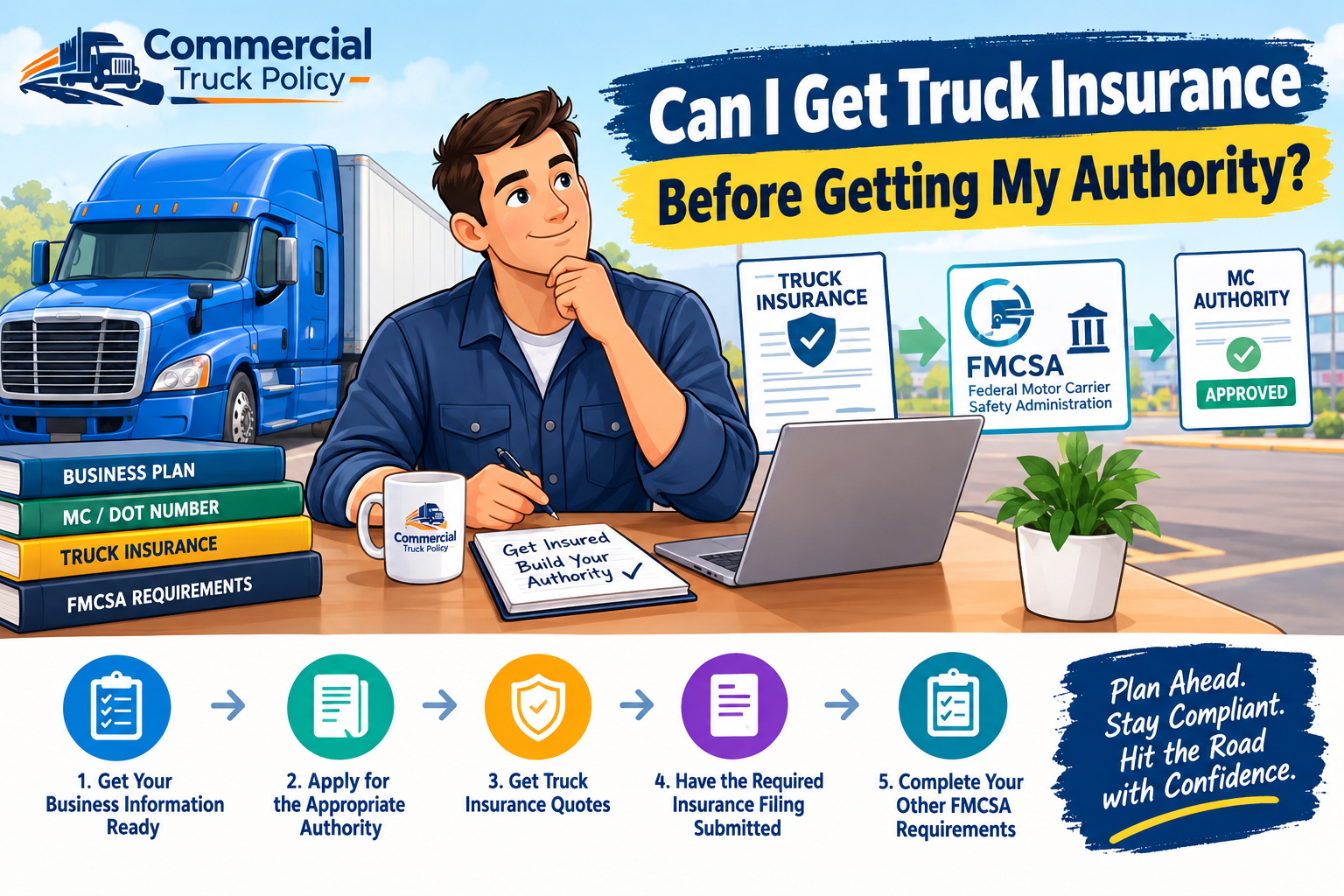
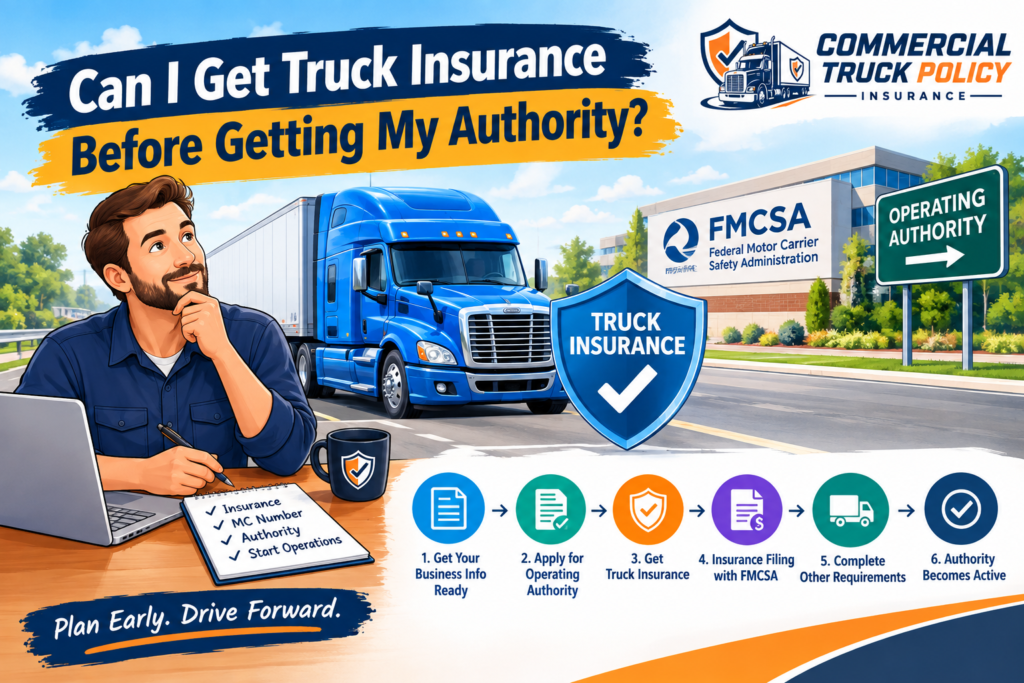
Step-by-Step Order:
- Submit FMCSA Registration Application: Apply for your USDOT number and applicable interstate operating authority. FMCSA – Department of Transportation
- Receive Pending Status & Docket Details: Your application is logged in the FMCSA system while awaiting mandatory filings and vetting. Trucking Insurance Services
- Contact a Commercial Trucking Insurance Specialist: Share your USDOT/docket details, equipment schedule, and driver history to get quotes and bind a policy.
- Electronic Filing (Form BMC-91 or BMC-91X): Your insurance provider electronically files proof of public liability coverage with the FMCSA—motor carriers cannot upload or file this form themselves. FMCSA – Department of Transportation
- Complete BOC-3 Filing: Ensure your Designation of Process Agents (Form BOC-3) is filed so legal documents can be served across operating states.
- Final Authority Activation: Once your filings are accepted and the mandatory federal waiting/protest period concludes, your operating authority switches to “Active” status. Trucking Insurance Services
(Regulatory Reference: You can review federal filing forms, minimum coverage levels, and electronic submission rules on the FMCSA Insurance Filing Requirements page.)
FMCSA – Department of Transportation
2. Why You Must Buy Insurance Before Your Authority Is Active
Under 49 CFR Part 387, the FMCSA will not activate for-hire operating authority until proof of mandatory public liability financial responsibility is officially on file.
FMCSA – Department of Transportation
If you wait until you think your authority is “Active” before purchasing insurance, your application will simply sit in pending status. Furthermore, the FMCSA enforces a strict 90-day window from the application date to complete your required insurance and BOC-3 filings. Missing that 90-day deadline results in dismissal of the application and forfeiture of your application fee.
Trucking Insurance Services+ 1
3. Three Critical Details New Truckers Need to Know
1. Binding Insurance Does Not Mean You Can Haul Freight Immediately
Simply paying your down payment, binding a policy, and carrying a Certificate of Insurance (COI) in your cab does not authorize you to haul for-hire freight across state lines. You must wait until the FMCSA updates your status from “Pending” to “Active”. Hauling regulated loads before active status can trigger roadside out-of-service orders, fines, and broker load cancellations.
Trucking Insurance Services
2. Match Business Information Letter-for-Letter
One of the most frequent causes of delayed or rejected electronic filings is a mismatch between your business name or address on your FMCSA registration and your insurance policy.
- Example: If your FMCSA record lists “Apex Trucking LLC” at “123 Main St,” but your insurance policy is written under “Apex Trucking L.L.C.” at “123 Main Street,” the filing can be rejected or delayed. Always verify exact legal spelling before your agent submits your filing.
3. Freight Broker Requirements vs. Federal Minimums
While 49 CFR § 387.9 sets a federal minimum of $750,000 in Public Liability for general non-hazardous property carriers operating vehicles of 10,001 lbs or more GVWR, most freight brokers and shippers contractually require $1,000,000 in Primary Auto Liability and $100,000 in Motor Truck Cargo coverage before tendering loads.
Wave Auto Transport
4. Pre-Quote Checklist Before Contacting an Agent
| Requirement | Details Needed | Why It Matters |
|---|---|---|
| USDOT & Docket Details | Active registration numbers from FMCSA | Required to link electronic filings to your authority |
| Exact Entity Name & EIN | Legal business name, address, and tax ID | Prevents electronic filing mismatches and delays |
| Vehicle Schedule | 17-digit VIN, year, make, model, GVWR, value | Needed for liability rating and physical damage quotes |
| Driver Qualifications | CDL numbers, state of issue, 3–5 year MVR/history | Key underwriting factor for new venture pricing |
| Cargo & Radius | Commodities hauled, states/radius, annual miles | Determines required limits and endorsements |
Frequently Asked Questions (FAQs)
1. Can I drive my truck for personal reasons while my authority is pending? If you own the truck and carry appropriate coverage (such as non-trucking liability or physical damage where applicable), you may operate the vehicle for strictly non-commercial personal use. You cannot haul regulated for-hire freight until your operating authority is officially Active.
2. How long after buying insurance does the FMCSA activate my authority?Insurers typically submit electronic filings (BMC-91 or BMC-91X) within 24 to 72 business hours of policy binding. Combined with the FMCSA’s vetting and public notice period, plan on roughly 2 to 3+ weeks from application to active authority.
Trucking Insurance Services+ 1
3. Do I file the BMC-91 or BMC-91X form myself? No. Only an authorized insurance company or financial responsibility filer registered with the FMCSA can electronically submit Form BMC-91 or BMC-91X on your behalf.
FMCSA – Department of Transportation
4. Why does my FMCSA public record show $750,000 when I bought a $1,000,000 liability policy?The FMCSA filing confirms you meet the statutory federal minimum for your operation. Your higher $1,000,000 limit is shown on your Certificate of Insurance (COI) provided to freight brokers and shippers.
Trucking Insurance Services+ 1
Editorial & Regulatory Disclaimer
This guide is researched and published for educational and informational purposes only and does not constitute legal, financial, or licensed insurance advice. FMCSA registration rules, filing forms, and underwriting requirements vary by operation type and jurisdiction. Always verify your status directly with the FMCSA and consult a licensed commercial transportation insurance agent before binding coverage.