
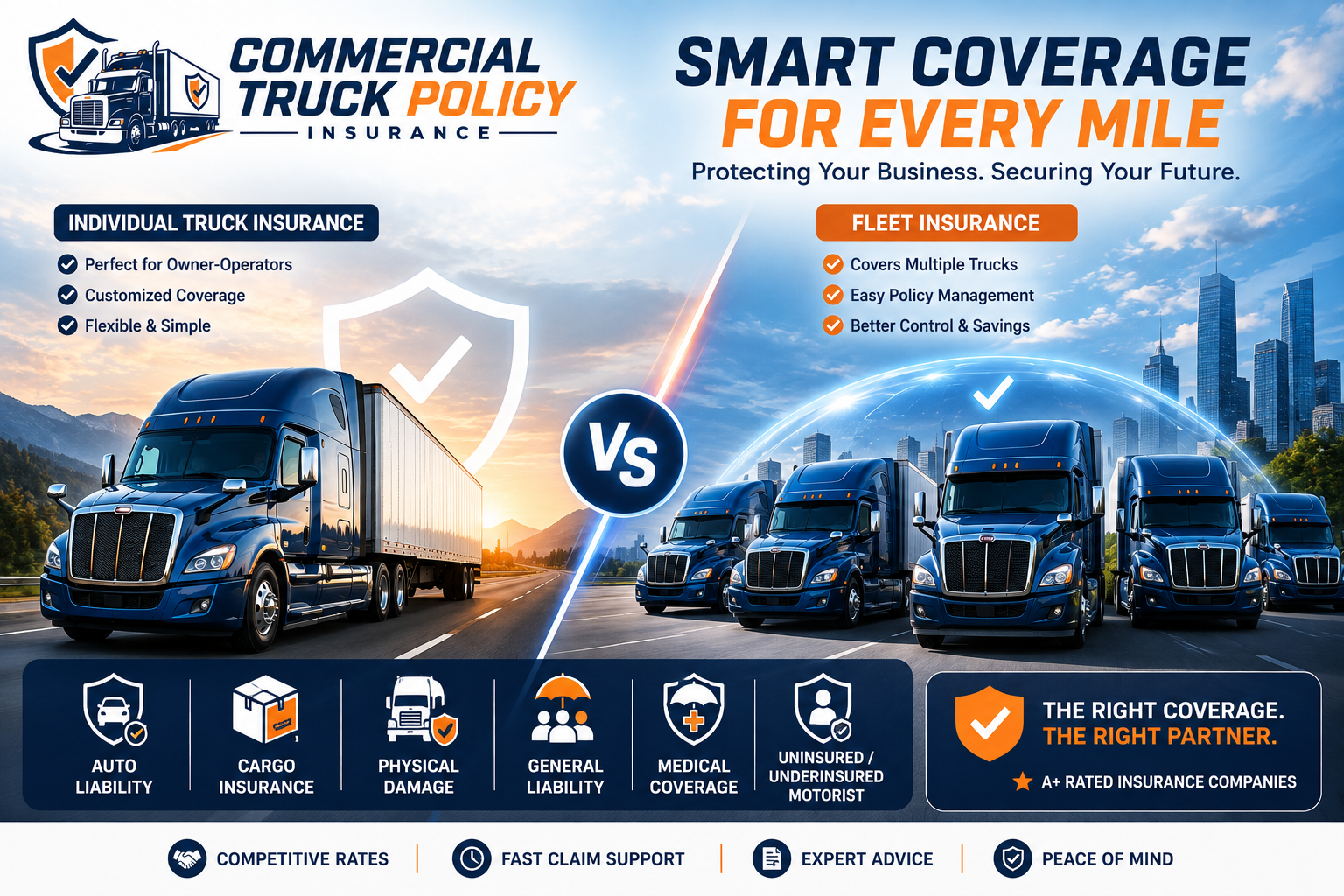
Fleet Insurance vs. Individual Truck Insurance: Which Is Better for Your Trucking Business? (2026 Guide)
Commercial truck insurance is one of the largest ongoing operational expenses for any motor carrier. As your business grows from operating a single semi-truck to running multiple power units, you will face an important financial decision:
Should you continue insuring each truck under individual policies, or switch to a unified Fleet Insurance program?
Both options serve distinct business sizes. While individual truck policies offer tailored, unit-specific coverage for owner-operators, fleet insurance provides centralized administration and potential volume savings for expanding motor carriers.
Here is a practical breakdown of how individual truck insurance and fleet insurance differ, the pros and cons of each, and how to determine which option fits your trucking business.
Quick Comparison: Fleet Insurance vs. Individual Policies
| Feature | Individual Truck Insurance | Commercial Fleet Insurance |
| Typical Vehicle Count | 1 to 2 trucks | 3 to 5+ trucks (varies by insurer) |
| Policy Structure | Separate policy per vehicle | Single unified policy for all units |
| Administration & Billing | Multiple renewals & separate invoices | One renewal date & consolidated billing |
| Driver Flexibility | Drivers are tied to specific assigned units | Drivers are approved at the overall fleet level |
| Underwriting Focus | Heavily rates the specific truck and driver | Evaluates overall safety, loss history & management |
| Ideal For | Single owner-operators & micro-fleets | Growing carriers, mid-sized & enterprise fleets |
1. What Is Individual Truck Insurance?
Individual truck insurance structures coverage on a single-vehicle basis. Each power unit has its own dedicated policy declaration, specified coverage limits, and assigned primary driver.
When It Works Best:
- Single Owner-Operators: If you own and drive one semi-truck, an individual commercial auto policy is the simplest and most cost-effective option.
- Specialized / Mismatched Equipment: If you operate two trucks with vastly different risk profiles (e.g., one standard dry van tractor and one specialized heavy-haul rig), individual policies prevent the high-risk unit from driving up the premium on the lower-risk vehicle.
Main Disadvantages:
- Administrative Burden: As you add a 3rd or 4th truck, managing multiple separate policies leads to staggered renewal dates, separate premium finance agreements, and extra paperwork.
- Rigid Driver Assignment: Adding a new relief driver requires listing them on a specific vehicle’s policy rather than approving them across your entire operation.
2. What Is Fleet Insurance?
Fleet insurance consolidates multiple commercial vehicles (tractors, box trucks, service vehicles, and trailers) under a single master policy.
While threshold rules vary among insurance carriers, most commercial underwriters classify a business as a “fleet” once it operates 3 to 5 power units.
Key Advantages of Fleet Insurance:
- Simplified Administration: You manage one master policy, one renewal date, and one monthly statement. Adding or removing a tractor or trailer takes a single policy endorsement.
- Fleet-Level Driver Approvals: Approved drivers can operate any vehicle in your fleet without needing separate policy endorsements for each truck.
- Loss-Run Credit Potential: Insurers rate fleets based on the overall loss ratio of the business. A carrier with 10 trucks and a clean safety record gets access to experience credits, lowering the average cost per truck compared to individual policies.
Main Disadvantages:
- One Bad Driver Affects All Vehicles: Because risk is pooled, a major loss or accident caused by one driver can increase premiums across the entire fleet during policy renewal.
- Stricter Safety Audits: Fleet underwriters examine your company’s FMCSA BASIC safety scores, driver hiring protocols, ELD compliance, and preventative maintenance schedules far more rigorously than for single-unit policies.
Is Fleet Insurance Automatically Cheaper?
Not necessarily. Switching to a fleet policy does not guarantee an immediate discount.
Commercial insurance rates depend primarily on risk exposure, driving history, and loss runs.
- Scenario A: A 5-truck fleet with clean MVRs, low driver turnover, and zero claims over 3 years will likely pay 10% to 20% less per truck under a fleet policy than under 5 individual policies.
- Scenario B: A 5-truck fleet with two recent at-fault accidents and high FMCSA violation scores may find fleet coverage significantly more expensive—or even face non-renewal—because underwriters view the overall management as high-risk.
Key Coverages Required (Regardless of Policy Type)
Whether you choose individual or fleet coverage, your insurance structure must satisfy both FMCSA legal minimums and freight broker contracts:
- Primary Auto Liability: Mandated by FMCSA (minimum $750,000 for general freight over 10,000 lbs GVWR; $1,000,000 required by most brokers).
- Motor Truck Cargo Insurance: Typically $100,000 limit to cover freight in transit.
- Physical Damage Insurance: Collision and Comprehensive coverage based on the Stated Actual Cash Value (ACV) of your tractors and trailers.
- Commercial General Liability (CGL): $1,000,000 to protect against non-driving business liabilities.
Which Option Should You Choose?
Choose Individual Policies If:
- You are an owner-operator running 1 or 2 trucks.
- Your drivers operate strictly assigned vehicles with distinct routes or specialized cargo.
- You are in your first year of operating under a new MC authority.
Choose Fleet Insurance If:
- You operate 3 or more power units.
- You regularly swap drivers between different trucks.
- You want to streamline bookkeeping, billing, and Certificate of Insurance (COI) management into a single master policy.
- You have established a strong safety track record with low loss ratios over the past 2 to 3 years.
Frequently Asked Questions (FAQs)
1. How many trucks do I need to qualify for fleet insurance?
Most commercial insurance carriers set the minimum fleet threshold at 3 or 5 power units. However, some specialized markets offer “micro-fleet” programs starting at 2 trucks.
2. Can I mix different types of vehicles on one fleet policy?
Yes. A commercial fleet policy can cover a mix of semi-tractors, box trucks, pickup trucks, and trailers under the same master policy structure.
3. What happens if I sell a truck mid-policy year on a fleet plan?
Your agent simply issues a policy endorsement deleting the unit. The unused portion of that truck’s premium is credited back to your account balance or reduces your remaining monthly installments.
Final Thoughts
Choosing between fleet insurance and individual truck policies comes down to fleet size, operational complexity, and administrative efficiency.
For single owner-operators, individual policies keep coverage clear and manageable. But as your fleet expands past three trucks, transitioning to a fleet policy simplifies policy management, streamlines driver scheduling, and rewards your safety record with better long-term rates.
Work with an experienced commercial transportation broker to compare both options side-by-side using your actual vehicle valuations, driver MVRs, and operating routes.
What Is an MCS-90 Endorsement?
Best Commercial Truck Insurance Companies in USA
FMCSA Insurance Requirements 2026: Complete Guide for Trucking Companies
Thank you for the detailed information and for explaining everything so clearly. You did a great job helping me understand the process. I really appreciate your effort and support. Great work! 👍