
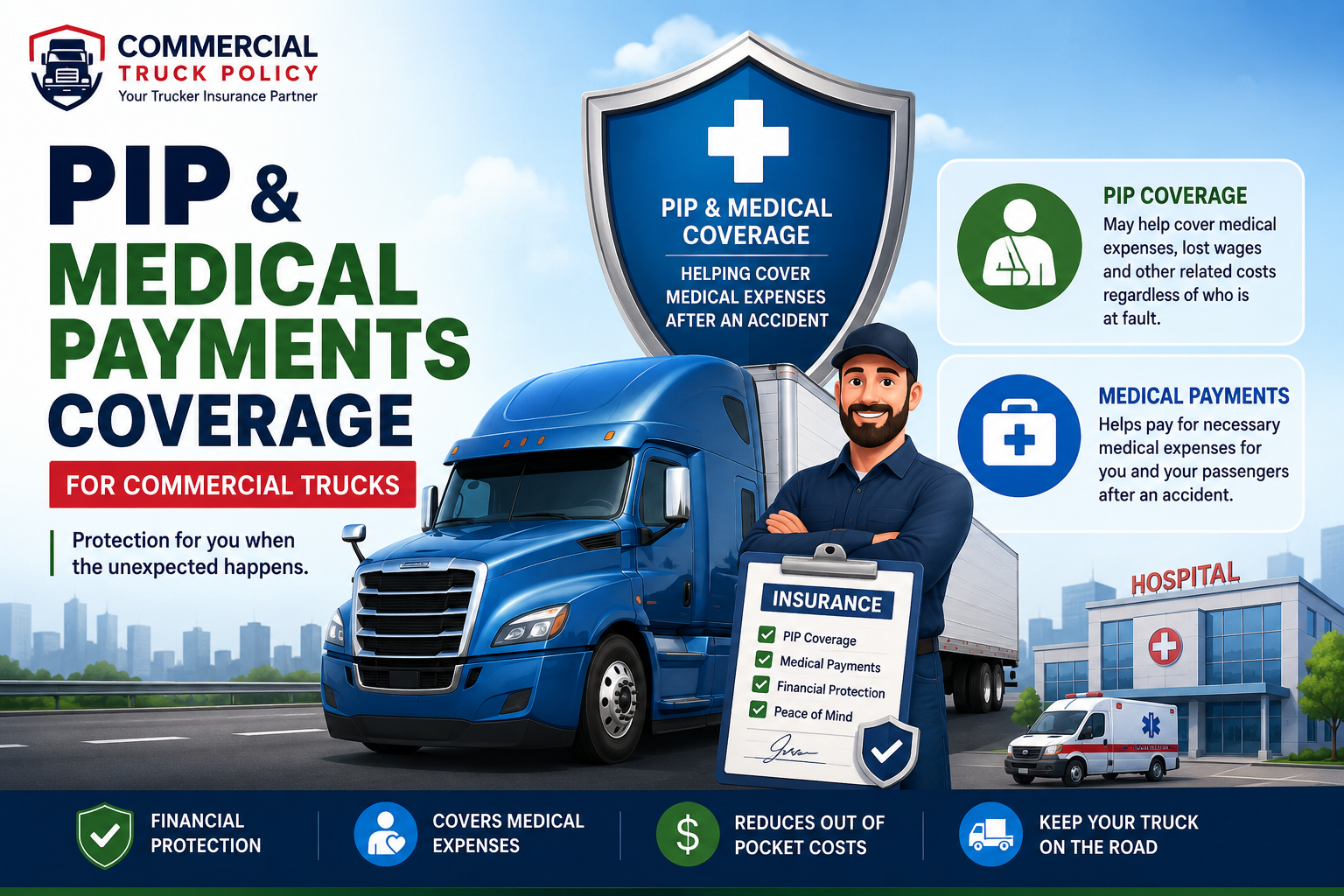
PIP vs. Medical Payments for Commercial Truck Insurance: What Truckers Must Know (2026 Guide)
When truck owners and owner-operators shop for commercial truck insurance, conversations usually revolve around Primary Auto Liability ($1,000,000 limits), Physical Damage, and Motor Truck Cargo Insurance.
However, there is a critical area of coverage that is often overlooked until an accident happens: Who pays for the truck driver’s medical bills if they are injured in a crash?
A common misconception among new owner-operators is assuming that their primary commercial liability policy covers their own medical bills. It does not. Commercial auto liability only pays for injuries and property damage caused to other people.
To cover your own medical treatment, emergency hospital visits, or lost wages following a collision, you need first-party medical coverage—primarily Personal Injury Protection (PIP) or Medical Payments Coverage (Med Pay).
Here is a practical breakdown of how PIP and Med Pay work in commercial trucking, how they differ by state, and which coverages owner-operators actually need.
Quick Comparison: PIP vs. Medical Payments (Med Pay)
While both cover medical expenses following a covered commercial vehicle accident regardless of who was at fault, their scope of protection is very different:
| Feature | Personal Injury Protection (PIP) | Medical Payments (Med Pay) |
| Primary Focus | Comprehensive post-accident injury protection | Direct, reasonable medical bills only |
| Hospital & Doctor Bills | Yes (Up to policy limits) | Yes (Up to policy limits) |
| Lost Wages / Income Replacement | Yes (In most PIP states) | No |
| Rehabilitation & Essential Services | Yes (e.g., child care, house cleaning) | No |
| Funeral Expenses | Yes (In most PIP states) | Yes (Limited benefit) |
| State Availability | Mandatory or optional in ~12 “No-Fault” states | Available in most states |
| Typical Policy Limits | $10,000 to $50,000+ | $1,000 to $10,000 (Low limits) |
1. What Is Personal Injury Protection (PIP) in Commercial Trucking?
Personal Injury Protection (PIP) is a form of no-fault coverage. This means that if you are injured in an accident, your PIP policy pays out eligible benefits immediately, regardless of whether you or the other driver caused the crash.
What PIP Covers:
- Emergency hospital treatments, surgeries, and doctor visits.
- Disability Income / Lost Wages: Reimburses a percentage of the income you lose while recovering from your injuries.
- Essential Services: Pays for household help (like childcare or yard maintenance) if your injury prevents you from handling daily tasks.
Is PIP Mandatory for Commercial Semi-Trucks?
It depends entirely on the state where your truck is registered.
- No-Fault States: States like Florida, New York, New Jersey, Michigan, and Utah mandate PIP coverage for registered motor vehicles.
- Commercial Exemptions: However, some states allow commercial trucks over 26,000 lbs GVWR to opt-out or waive PIP coverage in favor of other commercial injury policies. Always verify your specific state registration laws with your insurance broker.
2. What Is Medical Payments Coverage (Med Pay)?
Medical Payments Coverage (Med Pay) is a simpler, strict first-party medical coverage. It pays for necessary medical and dental expenses resulting from a covered trucking accident.
What Med Pay Covers:
- Ambulance rides and ER visits.
- X-rays, MRIs, surgical procedures, and hospital stays.
- Doctor co-pays and prosthetics.
Key Limitations of Med Pay:
- No Lost Wage Coverage: Med Pay will not replace your income if your injury keeps you out of the driver’s seat for six months.
- Low Limits: Commercial Med Pay policies typically carry smaller limits ($1,000, $2,500, or $5,000 per person). It is designed to pay immediate out-of-pocket medical expenses or cover health insurance deductibles, not long-term rehabilitation.
Why Primary Auto Liability Will NOT Pay Your Medical Bills
New authority owners often make a costly mistake by thinking: “I have a $1 Million Commercial Liability policy, so I am fully protected if I get hurt.”
Commercial Auto Liability strictly covers 3rd-party claims.
- If you jackknife on ice and hit a guardrail, your liability insurance pays for the guardrail repairs—it will not pay for your broken leg or hospital stay.
- If another driver hits you, their liability insurance may eventually pay your medical bills, but only after months of legal settlement negotiations or lawsuit proceedings.
Having first-party coverage (like PIP, Med Pay, or Occupational Accident Insurance) ensures your medical bills are paid immediately without waiting for fault determinations.
Essential Injury Options for Owner-Operators
If you operate as an independent owner-operator (sole proprietor or single-member LLC), standard Workers’ Compensation may not apply to you or may be too expensive. Consider these alternatives:
1. Occupational Accident Insurance (Occ Acc)
This is one of the most popular coverages for independent truck drivers. It acts like a specialized commercial disability policy:
- Covers medical expenses for job-related injuries (both on the road and while loading/unloading).
- Provides temporary or permanent disability income if you cannot drive.
- Includes accidental death and dismemberment (AD&D) benefits.
2. Workers’ Compensation
Mandatory in most states if you hire W-2 company drivers. If your trucking company employs drivers, Workers’ Comp is legally required to cover workplace injuries and lost wages.
Questions to Ask Your Insurance Agent Before Buying
- Does my state require mandatory PIP for commercial vehicles over 10,000 lbs GVWR?
- Are my medical bills covered if an accident occurs while loading/unloading freight at a customer’s dock?
- Does this policy include Medical Payments (Med Pay), and what is the per-person limit?
- If I am injured and cannot drive for 3 months, does this policy provide any lost wage replacement (PIP or Occupational Accident)?
- Does my health insurance cover commercial trucking accidents, or does it have motor vehicle exclusions?
Frequently Asked Questions (FAQs)
1. Is PIP required by FMCSA federal regulations?
No. The FMCSA’s financial responsibility minimums (such as 49 CFR Part 387 requiring $750,000 to $1M in liability) deal exclusively with public liability and property damage. First-party medical coverage like PIP or Med Pay is governed strictly by individual state insurance laws, not federal FMCSA rules.
2. Can I have both Med Pay and health insurance?
Yes. Med Pay can be used alongside primary health insurance. Truckers often use Med Pay to cover expensive health insurance deductibles and copays resulting from a commercial accident.
3. Does Med Pay cover injuries that happen while working on the truck in a mechanic shop?
Generally, Med Pay applies to injuries sustained while occupying, entering, or exiting the insured vehicle during transit or operation. Accidents occurring in a shop or terminal facility may require General Liability or Occupational Accident coverage instead.
Final Thoughts
Navigating commercial truck insurance requires protecting both your equipment and yourself. While Primary Auto Liability satisfies federal FMCSA regulations and broker contracts, Personal Injury Protection (PIP), Med Pay, and Occupational Accident Insurance protect your personal financial health when an accident occurs.
Before binding your policy, review your state’s registration requirements, check your personal health insurance terms, and consult with a licensed commercial transportation agent to ensure you have no gaps in driver injury coverage.
Fleet Insurance vs Individual Truck Insurance
What Is an MCS-90 Endorsement?