
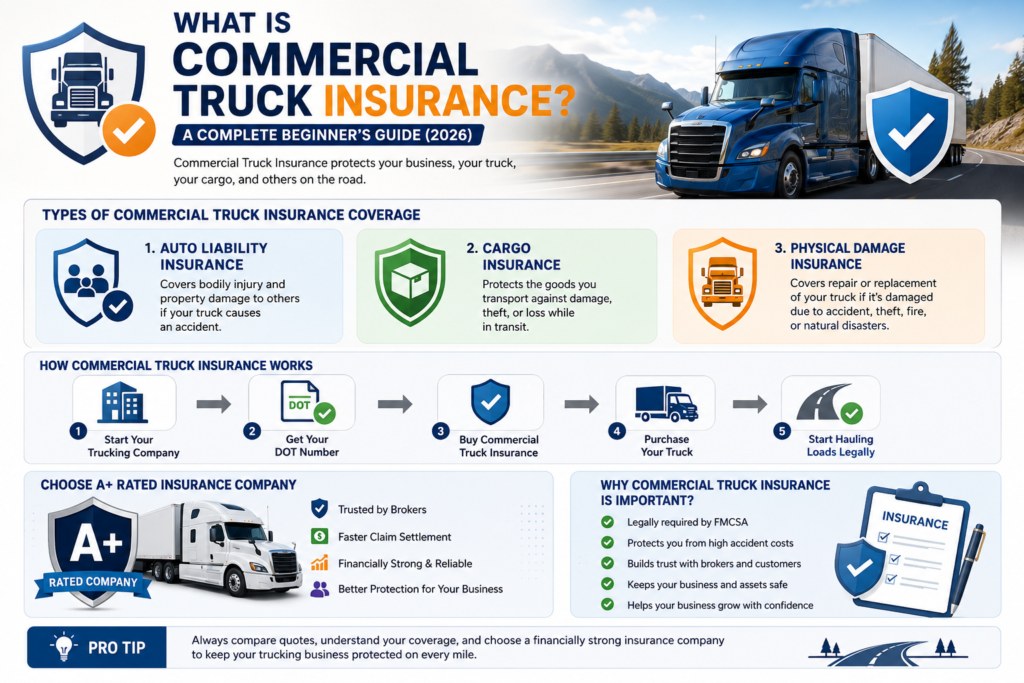
What Is Commercial Truck Insurance? A Complete Beginner’s Guide (2026)
The transportation and logistics industry is the primary backbone of the American economy. From retail goods and electronics to construction materials and medical supplies, over 70% of all domestic freight relies on commercial motor vehicles to reach its final destination.
Because heavy commercial trucks operate at high gross vehicle weights (GVWR) across interstate highways, commercial trucking is strictly regulated. For anyone planning to start a trucking company or become an independent owner-operator in 2026, understanding commercial truck insurance is your very first step toward building a compliant and profitable business.
Here is a practical beginner’s guide to how commercial truck insurance works, why it is essential before buying equipment, and how to structure your policy to gain instant trust with freight brokers.
Why Commercial Truck Insurance Is Your #1 Priority
Before you can legally operate a commercial truck in the United States, you must carry adequate commercial auto insurance.
In fact, securing insurance often comes before purchasing or leasing a vehicle. Financing companies, banks, and dealerships will contractually refuse to release a commercial tractor without proof of active physical damage and liability coverage.
Furthermore, the Federal Motor Carrier Safety Administration (FMCSA) will not activate a newly assigned USDOT or MC authority until your insurance provider electronically submits proof of financial responsibility.
Without a properly structured policy, you cannot:
- Receive active FMCSA operating authority.
- Register your commercial equipment with state DOT agencies or secure IFTA permits.
- Pass automated compliance checks on freight broker platforms (RMIS, Highway, MyCarrierPortal).
- Protect your personal and business assets against devastating lawsuit claims following a highway collision.
What Does Commercial Truck Insurance Cover?
Commercial truck insurance is a specialized, multi-layered policy program designed to protect motor carriers, drivers, freight, and third parties from catastrophic financial loss.
[Primary Auto Liability ($1M)] ➔ [Motor Truck Cargo ($100k)] ➔ [Physical Damage (ACV)] ➔ [Supplemental Policies]
Commercial Truck Insurance Companies in USA
1. Auto Liability Insurance (Primary Liability)
Primary Auto Liability is the single most critical coverage for every motor carrier. It is legally mandated by federal law before any commercial truck can operate on public roads.
- What It Covers: Third-party bodily injury, medical expenses, third-party vehicle repairs, structural damage, and legal defense costs resulting from an at-fault accident.
- FMCSA Federal Minimum: $750,000 for non-hazardous freight in vehicles over 10,000 lbs GVWR.
- Freight Broker Standard: $1,000,000 per occurrence. Relying solely on the federal minimum of $750,000 will restrict your business from booking over 90% of available load board freight.
2. Motor Truck Cargo Insurance
Driving safely is only half the job—you are also financially responsible for the freight inside your trailer.
- What It Covers: Physical damage, theft, fire, or total loss of cargo during transit.
- Broker Baseline Limit: $100,000 is the standard requirement for general dry van and flatbed freight. High-value commodities (reefer produce, electronics, auto hauling) often require limits of $250,000 to $500,000+.
3. Physical Damage Coverage (Collision & Comprehensive)
While primary liability protects third parties, Physical Damage covers your primary capital asset—your semi-truck and trailer.
- Collision: Pays for repairs if your rig collides with another vehicle, hits a stationary object, jackknifes, or rolls over.
- Comprehensive: Pays for non-collision losses including vehicle theft, cab fires, windshield breakage, animal strikes, or severe storm damage.
- Lender Requirement: Mandatory if your truck is financed or leased, calculated on the Stated Actual Cash Value (ACV) of the equipment.
Recommended Order of Coverage Acquisition
When setting up your trucking startup, structure your insurance package in this sequence:
- Primary Auto Liability ($1,000,000): Mandated for public highway operation and FMCSA authority activation.
- Motor Truck Cargo ($100,000): Mandated by freight brokers to book loads.
- Physical Damage Insurance: Mandated by lenders to protect vehicle financing.
- Commercial General Liability (CGL): Required by warehouses and terminals for non-driving operational risks ($1,000,000 limit).
- Supplemental Coverages: Add Bobtail/Non-Trucking Liability, Trailer Interchange, or Occupational Accident coverage based on your specific dispatch model.
Why Insurance Reputation Matters to Freight Brokers
Many new owner-operators focus strictly on meeting minimum legal filings, but insurance plays a direct role in your ability to secure profitable freight.
Freight brokers utilize automated compliance software to evaluate a carrier’s Certificate of Insurance (COI) before issuing a rate confirmation. Operating with a reputable, financially sound underwriter demonstrates professionalism and financial stability, giving brokers full confidence that claims will be settled swiftly if an accident occurs.
Admitted A-Rated Insurers vs. Risk Retention Groups (RRGs)
When shopping for quotes, you will encounter cheap options from Risk Retention Groups (RRGs) alongside traditional A-Rated Commercial Carriers. Understanding the difference is vital:
| Feature | Admitted A-Rated Insurers (e.g., Progressive, Great West) | Risk Retention Groups (RRGs) |
| A.M. Best Rating | A- to A++ (Excellent to Superior) | Unrated or low financial stability rating |
| Broker Acceptance | 100% Acceptance across all broker load boards | Frequently blacklisted/rejected by major brokers |
| State Guaranty Fund | Protected by state insolvency guaranty funds | No state guaranty protection if the RRG fails |
| Claims Settlement | Fast, standardized adjusting processes | Potential delays or restrictive payout terms |
⚠️ Key Industry Warning: While an RRG policy may offer a lower upfront monthly payment, it can destroy your cash flow if major freight brokers reject your carrier setup due to your insurance provider. Always verify broker acceptance before binding an RRG policy.
Smart Buying Checklist for 2026
- Compare Multiple Quotes: Gather at least 3 comparative quotes through specialized commercial transportation brokers.
- Verify Listed Drivers: Confirm directly with the insurance carrier that all CDL drivers are explicitly listed on your policy declaration page.
- Disclose Accurate Radiuses: Report your true geographic operating boundaries (Local, Regional, or OTR) to prevent claim denials during ELD/IFTA audits.
- Budget for Upfront Down Payments: Plan for a 15% to 25% initial deposit to bind coverage and trigger your electronic FMCSA BMC-91X filing.
Frequently Asked Questions (FAQs)
1. Can I get commercial truck insurance before getting my DOT number?
You can request insurance quotes using your business details, but the insurer will need your pending USDOT and MC docket numbers to issue final policy binders and submit electronic filings to the FMCSA.
2. How long does it take for insurance filings to activate my MC authority?
Once your insurer electronically files Form BMC-91X, it typically clears the FMCSA database within 24 to 72 hours, followed by the mandatory 10-calendar-day public protest period.
3. What is the average cost of beginner commercial truck insurance in 2026?
For a new MC authority operating one semi-truck (general freight, OTR), first-year insurance typically costs between $12,000 and $18,000 annually ($1,000 to $1,500/month), depending on driver CDL experience and garaging zip code.
Final Thoughts
Commercial truck insurance is far more than a regulatory checkbox—it is the financial safeguard that protects your equipment, builds trust with freight brokers, and secures your business’s future.
By investing in an A-rated insurance carrier, selecting policy limits that meet broker standards ($1M Liability / $100k Cargo), and maintaining accurate operational records, you set your trucking venture up for long-term growth and success in 2026.