
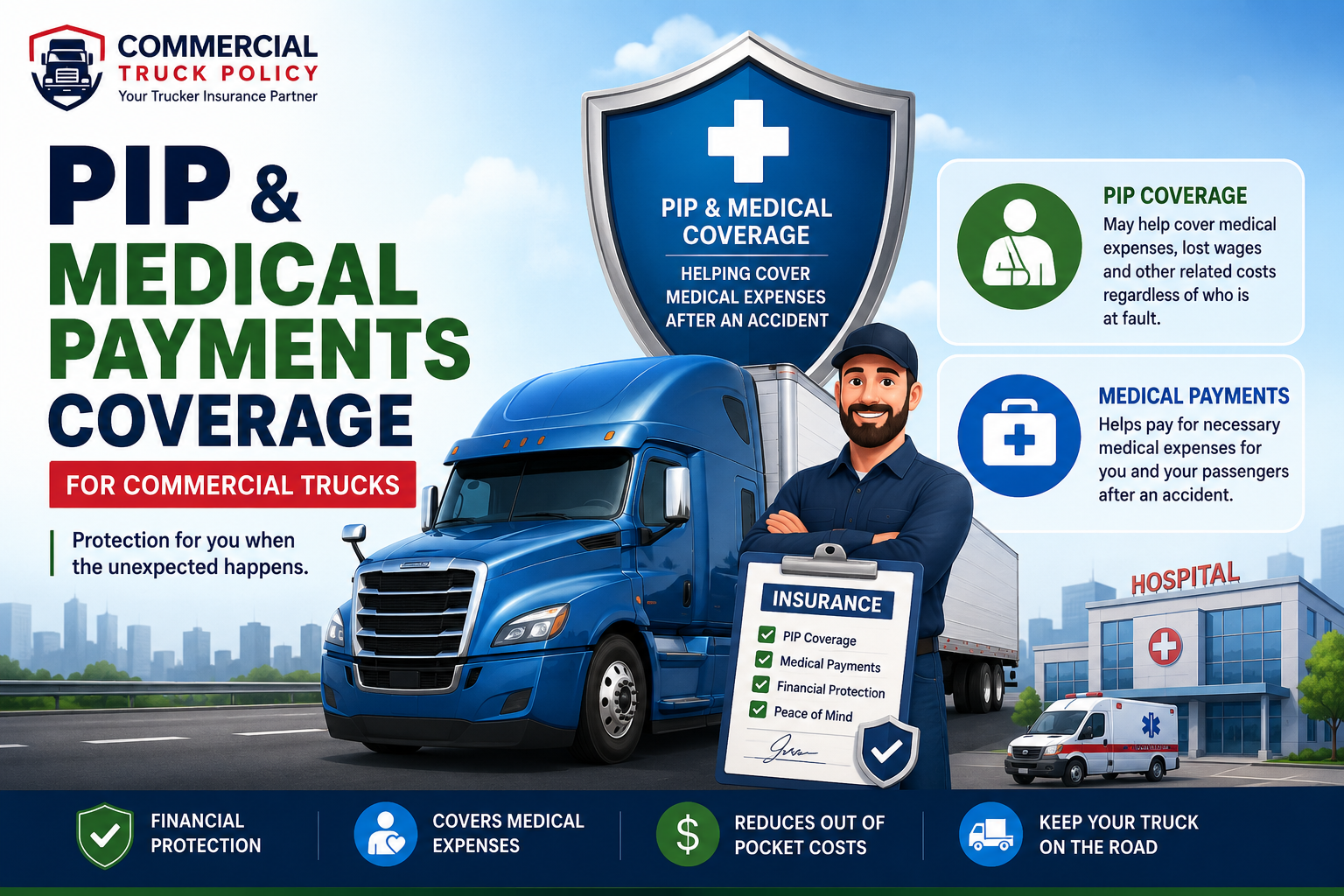
PIP and Medical Payments for Commercial Truck Insurance: What Truckers Should Know
Commercial truck insurance is usually discussed in terms of liability, physical damage, cargo, and other major coverages. But there is another part of a commercial auto policy that truck owners and owner operators should understand: coverage for medical expenses after an accident.
Two terms that often come up are Personal Injury Protection (PIP) and Medical Payments Coverage (Med Pay).
Although both can help with certain medical expenses after an accident, they are not the same coverage. Their availability, requirements, and benefits can also depend on the state where the vehicle is registered and how the truck is used.
For truckers, understanding these differences before purchasing a policy can make it easier to choose coverage that fits their business and personal situation.
What Is PIP in Commercial Truck Insurance?
Personal Injury Protection, commonly called PIP, is coverage designed to help pay certain expenses related to injuries after an auto accident.
Depending on the policy and applicable state law, PIP may help with medical expenses and may also provide benefits for other accident-related costs. Some PIP systems can provide benefits regardless of who was responsible for the accident.
However, PIP rules are not the same across the United States. Some states require PIP for certain vehicles, some allow drivers to reject or waive it in particular circumstances, and other states do not use traditional PIP coverage.
That is especially important for commercial truck owners because a commercial vehicle may be subject to different insurance rules than a personal vehicle.
Therefore, a trucker should not assume that PIP automatically works the same way on every commercial truck insurance policy.
What Is Medical Payments Coverage?
Medical Payments Coverage, often called Med Pay, can help pay reasonable medical expenses resulting from injuries sustained in an accident involving a covered vehicle, subject to the policy’s terms and limits.
The exact benefits depend on the insurance policy and state regulations.
For example, if a truck driver is injured in a covered accident, Med Pay may help with eligible medical expenses such as hospital treatment, doctor visits, or other covered medical services.
Unlike liability insurance, Medical Payments Coverage is generally focused on eligible medical expenses for covered persons rather than paying another party because the insured was legally responsible for an accident.
PIP vs. Medical Payments: What Is the Difference?
PIP and Medical Payments can sound similar because both may help with medical expenses after an accident. The major difference is usually the scope of benefits.
| Feature | PIP | Medical Payments |
|---|---|---|
| Main purpose | Injury-related benefits | Medical expenses |
| Medical bills | May be covered | May be covered |
| Lost income | May be included depending on policy/state | Generally not the primary purpose |
| Other expenses | May be available depending on state/policy | Usually more limited |
| State requirements | Vary significantly | Vary by state and policy |
| Availability | Depends on state and commercial policy | Depends on insurer, state and policy |
This is a general comparison. The actual benefits are determined by the policy language and applicable state law.
Why Medical Coverage Matters to Truckers
Truck driving involves long hours on the road, heavy equipment, changing weather conditions, traffic, and exposure to many different driving situations.
Even when a truck driver is careful, an accident can happen because of another driver’s actions, road conditions, mechanical problems, or other circumstances.
The financial impact of an accident is not limited to damage to the truck.
A serious accident can also result in:
- Emergency medical treatment
- Hospital bills
- Doctor appointments
- Diagnostic testing
- Rehabilitation
- Time away from work
- Other accident-related expenses
This is why it can be useful for truck owners and owner operators to understand what their insurance policy does—and does not—cover for injuries.
Does Commercial Truck Liability Insurance Pay for the Truck Driver’s Medical Bills?
This is one of the most common questions.
Generally, commercial auto liability coverage is designed to protect the insured when they are legally responsible for bodily injury or property damage to another party.
It is not the same thing as having first-party medical coverage for the insured driver.
For example, suppose a truck driver causes an accident and another person is injured. Liability coverage may respond to the covered claim according to the policy terms and applicable law.
But if the truck driver is injured, the driver may need another source of coverage for their own medical expenses.
That is where coverages such as PIP or Medical Payments may become relevant, depending on the policy and state.
FMCSA’s federal insurance requirements focus on financial responsibility for covered motor carriers, and the required amount can vary based on the type of operation, vehicle, cargo, and authority involved.
Is PIP Required for Commercial Trucks?
There is no single nationwide rule that makes PIP mandatory for every commercial truck in the United States.
Insurance requirements can vary from state to state and can also depend on the type of commercial vehicle and operation.
This is an important distinction because FMCSA federal requirements and state insurance requirements are not exactly the same thing.
A motor carrier operating under federal authority must meet applicable federal financial responsibility requirements. FMCSA states that operating authority will not be granted until the required minimum levels of financial responsibility are on file.
However, whether PIP is required or available for a particular commercial vehicle can depend on state law and the policy being purchased.
For this reason, truckers should check the requirements applicable to their operating state rather than relying on a general rule found online.
PIP for Owner Operators
Owner operators should pay particular attention to injury coverage.
An owner operator may have commercial auto liability coverage for the business, but that does not automatically mean every medical expense for the owner operator will be covered.
Depending on the business arrangement, the owner operator may have access to other forms of coverage, such as occupational accident coverage, workers’ compensation where applicable, health insurance, PIP, or Medical Payments coverage.
These coverages serve different purposes.
Before purchasing a policy, an owner operator should ask the insurance agent:
- Who is covered if the driver is injured?
- What medical expenses are covered?
- Is PIP available in my state?
- Is Medical Payments coverage available?
- What are the coverage limits?
- Are there exclusions?
- Does the coverage apply when the truck is being used for business?
- Is another type of injury coverage recommended for my operation?
Getting clear answers to these questions can prevent confusion after an accident.
Medical Payments Coverage for Commercial Truck Drivers
Medical Payments coverage can be useful when a policy provides it and the limits are appropriate for the insured’s needs.
However, truckers should not look at the coverage name alone.
Two policies can have different conditions, limits, exclusions, and definitions even when they appear to offer similar coverage.
For example, one policy may have a relatively small Medical Payments limit while another may provide a higher limit. The people who qualify as insureds or covered persons can also depend on the policy language.
This is why comparing the actual policy details is more important than simply choosing a policy because it contains the words “Medical Payments.”
PIP and Med Pay Are Not a Replacement for Liability Insurance
One important point should be clear: PIP or Medical Payments coverage does not replace commercial auto liability insurance.
Liability coverage serves a different purpose.
For a commercial trucking business, liability coverage can be one of the most important parts of the insurance program because accidents involving commercial vehicles can create significant third-party claims.
FMCSA identifies minimum financial responsibility requirements under 49 CFR Part 387, with requirements depending on the carrier and operation. For example, its current filing chart lists different BIPD limits for different types of motor carriers and cargo.
Medical-related coverage should therefore be viewed as one part of a broader commercial trucking insurance program.
What Other Commercial Truck Insurance Coverages Should Truckers Consider?
Depending on the operation, a trucking company may need several types of coverage.
Common coverages can include:
Auto Liability
Protects against covered third-party bodily injury and property damage claims for which the insured is legally responsible.
Physical Damage
Can help cover damage to the insured truck from covered causes of loss, subject to the policy deductible and terms.
Motor Truck Cargo
Designed to cover covered loss or damage to cargo being transported, subject to policy conditions and exclusions.
General Liability
Can address certain third-party claims arising from business activities that are not covered under the commercial auto liability portion of the policy.
Trailer Interchange
May provide coverage for certain trailers in the insured’s possession under a trailer interchange agreement, depending on the policy.
Medical Payments or PIP
May help with eligible injury-related medical expenses depending on state law, policy terms, and coverage availability.
The right combination depends on the type of trucking operation, equipment, cargo, drivers, contracts, and state requirements.
How Much Medical Coverage Does a Trucker Need?
There is no universal amount that works for every trucker.
The appropriate limit depends on several factors, including:
- Type of trucking operation
- State requirements
- Number of drivers
- Whether the truck is owner-operated
- Existing health insurance
- Other available injury benefits
- Policy cost
- Deductibles and coverage limits
A trucker should consider both the cost of the coverage and the potential financial exposure from an accident.
The cheapest policy is not necessarily the best policy if it leaves important gaps in protection.
Questions to Ask Before Buying Commercial Truck Insurance
Before purchasing a commercial truck insurance policy, ask the insurance agent to explain the medical-related coverage clearly.
You can ask:
“Does this policy include PIP or Medical Payments coverage?”
“Who is covered if I am injured in an accident?”
“What are the limits?”
“Does this coverage apply to my commercial truck operation?”
“Are there any exclusions I should know about?”
“What other injury coverage should I consider?”
These questions can help you understand your policy before an accident occurs.
Final Thoughts
PIP and Medical Payments coverage can be confusing for commercial truck owners because the rules and available coverage can vary depending on the state, insurer, policy, and type of trucking operation.
The most important thing is to understand that commercial truck liability insurance and injury-related medical coverage serve different purposes.
Liability coverage is generally designed to address covered third-party claims when the insured is legally responsible. PIP and Medical Payments, when available, may provide certain benefits for injuries or medical expenses under the policy’s terms.
For owner operators and trucking companies, reviewing these coverages with a qualified insurance professional can help identify potential gaps before an accident happens.
Insurance requirements can also change, and federal requirements are different from state-specific insurance rules. FMCSA currently states that motor carriers must maintain applicable financial responsibility filings and that requirements vary according to factors such as operation type, cargo, and vehicle.
Always review your actual insurance policy and applicable state requirements before making a coverage decision.
Frequently Asked Questions
Is PIP the same as Medical Payments?
No. Both can help with certain medical expenses after an accident, but they are different coverages and may provide different benefits. PIP can potentially provide broader injury-related benefits depending on state law and the policy.
Do all commercial trucks need PIP?
No. PIP requirements and availability vary by state and by the type of commercial vehicle and policy.
Does commercial truck liability insurance cover the driver’s own injuries?
Liability insurance generally addresses covered third-party claims for which the insured is legally responsible. A driver’s own injury may require another applicable coverage, depending on the circumstances.
Is Medical Payments coverage worth considering?
It can be worth considering, particularly for truckers who want additional coverage for eligible medical expenses. Whether it is appropriate depends on the driver’s situation, existing coverage, state law, and policy terms.
Can an owner operator get medical-related coverage?
Potentially, yes. Available options can include PIP, Medical Payments, occupational accident coverage, workers’ compensation where applicable, and other forms of coverage. The appropriate option depends on the owner operator’s circumstances and state.
Where can truckers check federal insurance requirements?
FMCSA publishes federal financial responsibility and insurance filing requirements for regulated motor carriers. Requirements should be checked directly with FMCSA and the applicable state authorities because requirements can vary by operation.
Fleet Insurance vs Individual Truck Insurance
What Is an MCS-90 Endorsement?