Owned, Non-Owned, Trailer Interchange & Rental Trailer Insurance: Complete Guide
If you operate a commercial trucking business, you may use different trailers during your day-to-day operations. Sometimes the trailer belongs to your company, while in other situations you may use a trailer owned by another carrier, a rental company, or a customer.
This is where insurance terminology can become confusing.
Owned trailer, non-owned trailer, trailer interchange, and rental trailer are not necessarily the same thing. Each situation can create different insurance responsibilities, and the coverage available to you can depend on your commercial auto policy, endorsements, contracts, and the circumstances of a loss.
Understanding these differences before an accident or theft occurs can help trucking companies avoid unexpected coverage problems.
What Is an Owned Trailer?
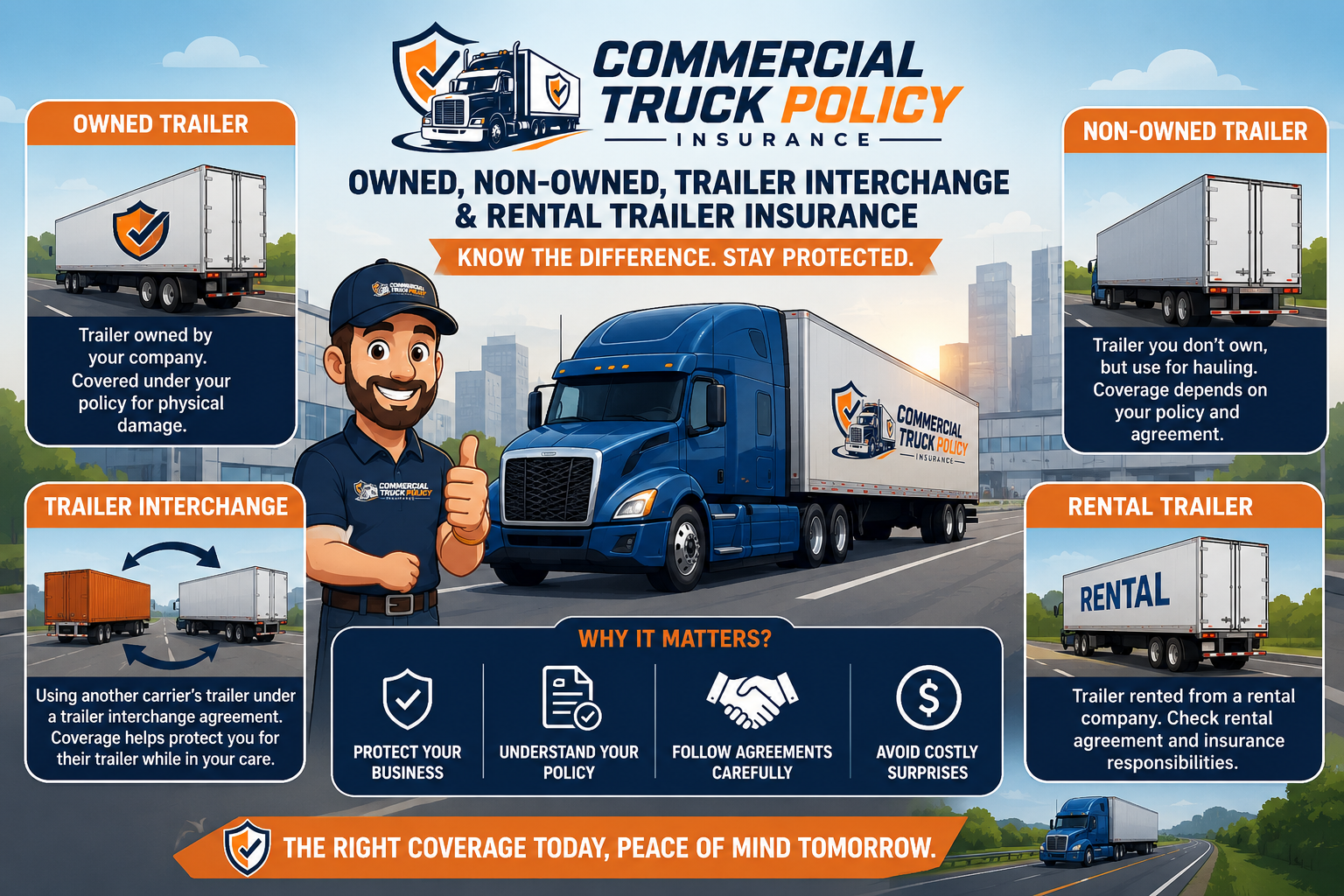
An owned trailer is a trailer that belongs to your trucking company or is titled/owned by your business.
For example, suppose your company owns a tractor and a 53-foot dry van trailer. You use that trailer to transport freight for your customers.
Because the trailer is your property, you may want to consider coverage for physical damage to the trailer. Depending on the policy, this can help protect against covered losses such as an accident, theft, fire, or other covered event.
Example of an Owned Trailer
Your trucking company owns:
- One semi-truck
- One 53-foot dry van trailer
While hauling a load, the trailer is involved in a covered accident and suffers significant damage.
If the trailer is properly scheduled and covered under the applicable physical damage coverage, the policy may respond according to its terms, limits, deductible, and exclusions.
The important point is that you own the trailer, so your insurance needs are different from a situation where you are borrowing or renting someone else’s trailer.
What Is a Non-Owned Trailer?
A non-owned trailer is a trailer that your company does not own but uses or has in its possession.
For example, a trucking company may use a trailer belonging to another party. The trailer could be supplied by a customer, another business, or another party under a particular business arrangement.
The biggest issue is determining who owns the trailer and under what agreement your company is using it.
Non-owned trailer situations can vary significantly. The insurance that applies depends on the wording of your policy and the agreement between the parties.
Example of a Non-Owned Trailer
Imagine that your company owns the tractor but does not own the trailer.
You are given a trailer owned by another company to transport freight. During your possession, the trailer is damaged in an accident.
You cannot simply assume that your regular truck insurance will automatically pay for the trailer.
The policy needs to be reviewed to determine whether the trailer and the particular loss are covered.
What Is Trailer Interchange Insurance?
Trailer interchange insurance is designed for certain situations where a trucking company takes responsibility for another party’s trailer under a trailer interchange agreement.
A trailer interchange agreement generally establishes the responsibilities of the parties when one carrier takes possession of another carrier’s trailer.
For example:
Carrier A → Trailer → Carrier B
Carrier B takes possession of Carrier A’s trailer and uses it for transportation.
If the trailer is damaged while in Carrier B’s possession, the agreement may make Carrier B responsible for the damage.
This is where trailer interchange coverage can become important.
Example
Suppose your trucking company has a trailer interchange agreement with another motor carrier.
You pick up their trailer and begin transporting a load. While the trailer is in your custody, it is involved in a covered accident.
If your policy includes appropriate trailer interchange coverage, the policy may provide coverage for covered physical damage to the trailer, subject to the policy’s terms, limits, deductible, and exclusions.
Trailer Interchange Is Not the Same as Owned Trailer Coverage
This distinction is important.
With an owned trailer:
You own the trailer.
With trailer interchange:
Someone else owns the trailer, and you have responsibility for it under an interchange arrangement.
That difference can affect what type of insurance coverage you need.
What Is a Rental Trailer?
A rental trailer is a trailer that your company obtains from a rental company or another provider under a rental agreement.
For example, a trucking company may rent a dry van trailer because:
- Its own trailer is being repaired
- It needs additional equipment
- A temporary increase in freight requires another trailer
- It does not want to purchase another trailer
The rental agreement may contain specific requirements regarding insurance and responsibility for damage.
Example of a Rental Trailer
Your company owns a tractor but rents a 53-foot trailer for 30 days.
During the rental period, the trailer is damaged in an accident.
Before assuming your insurance will cover the loss, you should review:
- Your commercial auto policy
- Applicable endorsements
- The rental agreement
- The insurance requirements of the rental company
- Any deductible or coverage limitations
Rental arrangements can differ, so the exact terms matter.
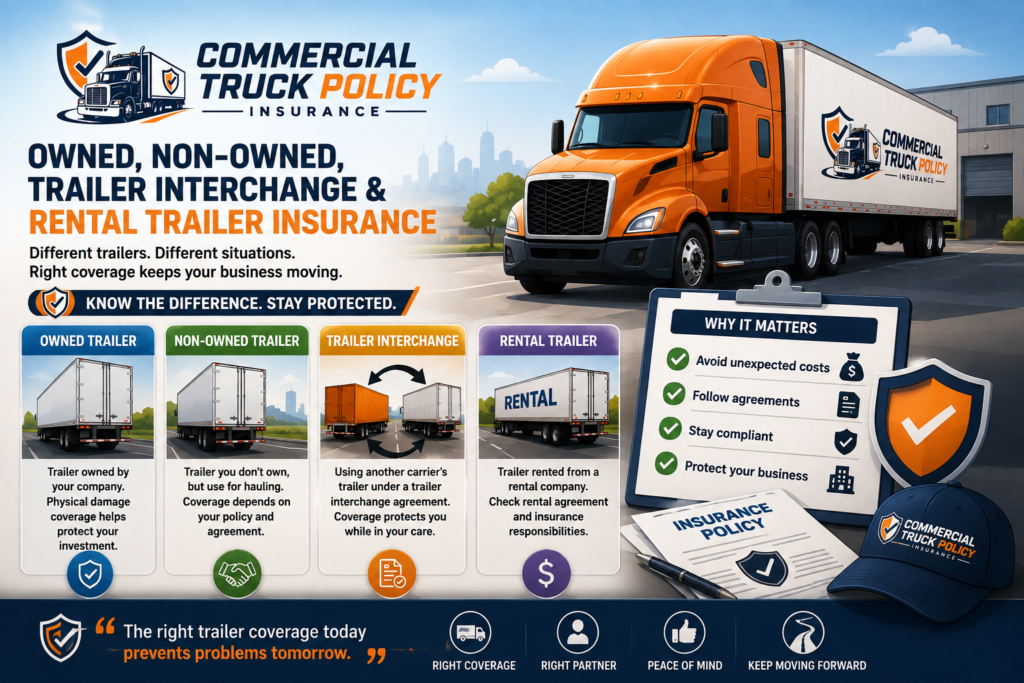
Owned vs Non-Owned vs Trailer Interchange vs Rental Trailer
The easiest way to understand the difference is to look at ownership and responsibility.
| Trailer Type | Who Owns It? | Typical Situation |
|---|---|---|
| Owned Trailer | Your company | Your business purchased and owns the trailer |
| Non-Owned Trailer | Another party | Your company uses a trailer it does not own |
| Trailer Interchange | Another carrier/party | Trailer is used under an interchange agreement |
| Rental Trailer | Rental/provider company | Trailer is being used under a rental agreement |
However, these categories can overlap from a practical standpoint. For example, a rental trailer is also not owned by your company. That does not mean every rental trailer automatically falls under the same coverage as a trailer obtained through a trailer interchange agreement.
The agreement and policy wording are critical.
Why Trucking Companies Should Understand Trailer Coverage
A trailer can represent a significant financial investment. Even a temporary trailer arrangement can create liability and contractual responsibilities.
One common mistake is assuming:
“My truck is insured, so every trailer I use must also be insured.”
That assumption can be dangerous.
Commercial trucking policies can contain specific definitions, exclusions, limits, deductibles, and endorsements. The coverage available for a trailer may depend on how the trailer came into your possession and what your policy actually says.
Before using another company’s or rental company’s trailer, it is a good idea to understand your insurance requirements.
What Should Truckers Check Before Using a Trailer?
Before taking possession of a trailer that your company does not own, consider checking the following:
1. Who Owns the Trailer?
Confirm whether the trailer belongs to:
- Your company
- Another motor carrier
- A customer
- A rental company
- Another third party
Ownership can affect the type of coverage required.
2. Is There a Written Agreement?
If you are using another company’s trailer, make sure you understand the written agreement.
Look for provisions covering:
- Damage responsibility
- Theft
- Maintenance
- Insurance requirements
- Deductibles
- Reporting obligations
3. Does Your Policy Specifically Address the Trailer?
Do not rely only on a verbal statement that the trailer is covered.
Ask your insurance agent or broker to confirm whether your policy provides the coverage required for the specific trailer arrangement.
4. What Is the Deductible?
Even when a loss is covered, you may have to pay a deductible.
Understanding the deductible beforehand can help you plan for a potential claim.
5. Are There Coverage Limits?
A policy may have a specific limit for certain types of trailer coverage.
Make sure the limit is appropriate for the value of the equipment you are responsible for.
Common Mistakes Trucking Companies Make
Mistake 1: Assuming Non-Owned Means Automatically Covered
A trailer being non-owned does not automatically mean that every type of damage is covered.
The policy language and circumstances matter.
Mistake 2: Confusing Trailer Interchange With Rental
Trailer interchange and rental arrangements can involve different contractual responsibilities.
A trucking company should not assume that one endorsement automatically satisfies every rental or interchange requirement.
Mistake 3: Ignoring the Contract
Insurance is only one part of the picture.
A trailer agreement may make your company responsible for certain losses even when you did not expect to assume that responsibility.
Mistake 4: Waiting Until After an Accident
The worst time to discover a coverage problem is after a trailer has already been damaged or stolen.
It is better to discuss the arrangement with your insurance professional before taking possession of the trailer.
Which Trailer Coverage Do You Need?
There is no single answer for every trucking company.
Your insurance needs can depend on:
- Trailer ownership
- Type of trucking operation
- How the trailer is being used
- Contractual responsibilities
- Value of the equipment
- Type of freight
- State and federal requirements
- Your commercial insurance policy
For an owned trailer, physical damage coverage may be appropriate.
For certain trailers belonging to another carrier and used under an interchange agreement, trailer interchange coverage may be relevant.
For rental equipment, the rental agreement and your insurance policy should be reviewed together.
For non-owned trailers, the exact circumstances should be discussed with your insurance professional because “non-owned” can cover different situations depending on the policy.
Final Thoughts
Understanding the difference between owned, non-owned, trailer interchange, and rental trailers is an important part of managing commercial trucking insurance.
The simplest way to remember the basic distinction is:
Owned Trailer: Your company owns it.
Non-Owned Trailer: Your company does not own it but is using or has possession of it.
Trailer Interchange: You have another party’s trailer under an interchange arrangement.
Rental Trailer: You have obtained the trailer through a rental agreement.
The names may sound similar, but the insurance responsibilities can be different.
Before taking possession of a trailer that your company does not own, review the agreement and confirm your insurance coverage with a licensed insurance professional. This can help you understand your responsibilities before a claim occurs rather than discovering a coverage issue afterward.
Disclaimer: This article is provided for general educational and informational purposes only. Insurance coverage, requirements, exclusions, and policy terms vary by insurer, state, business operation, and contract. It is not legal or insurance advice. Speak with a licensed insurance professional about your specific situation.
PIP and Medical Payments for Commercial Truck Insurance