
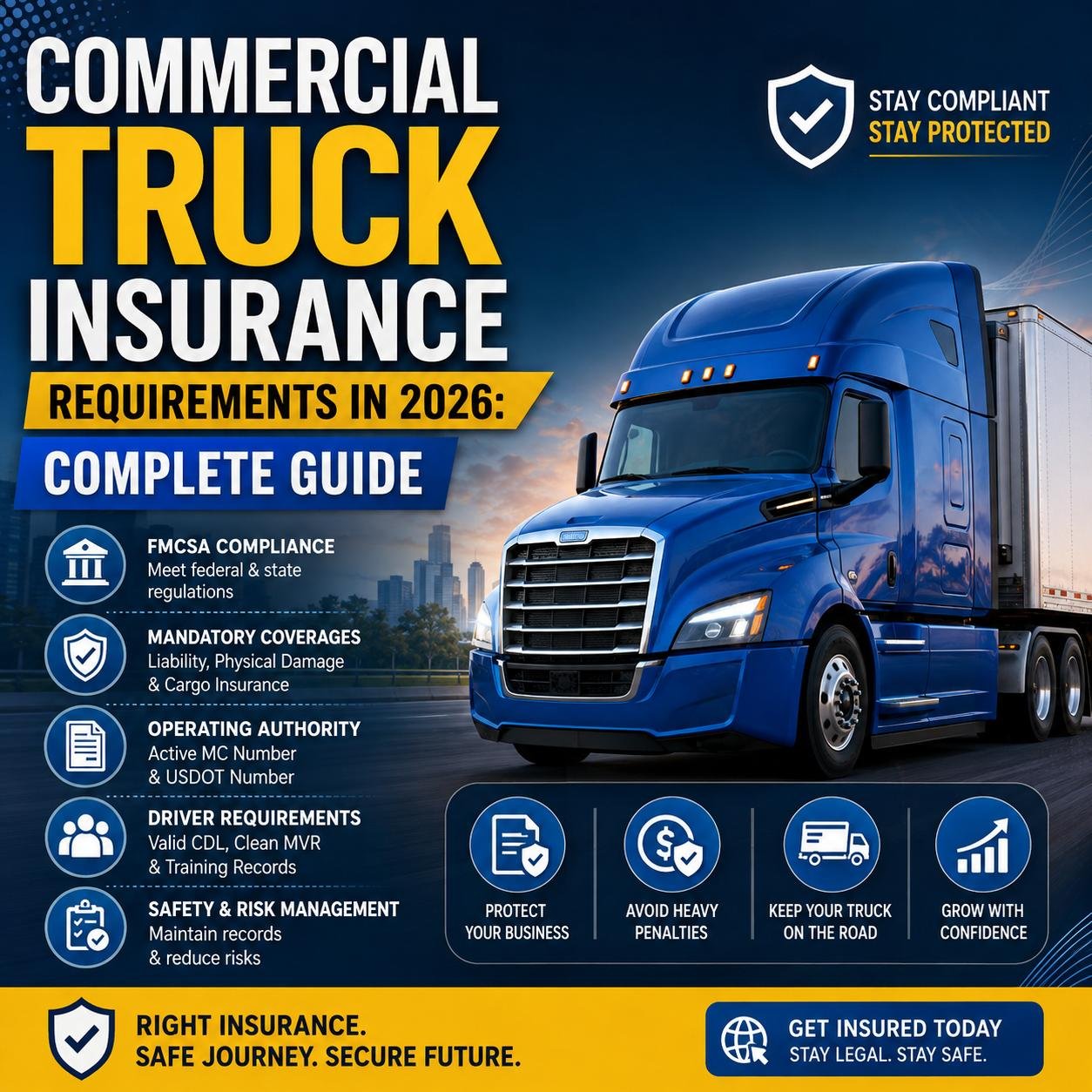
FMCSA Insurance Requirements 2026: Complete Guide for Trucking Companies
If you are planning to start a new trucking company or already operate a trucking business, understanding the FMCSA insurance requirements is essential. Many truck owners and new carriers are confused about how much liability insurance they need, what documents an insurance company requires, and whether a broker may require higher coverage limits.
In this guide, we will explain the FMCSA insurance requirements for 2026, the documents generally needed to obtain a commercial truck insurance quote, and the common insurance coverages trucking companies should consider.
Important: Federal insurance requirements can vary depending on your type of operation, cargo, vehicle, and operating authority. Always verify your specific requirements with FMCSA and your insurance professional before purchasing a policy.
What Is FMCSA?
The Federal Motor Carrier Safety Administration (FMCSA) is a U.S. Department of Transportation agency responsible for regulating interstate commercial motor carriers, brokers, freight forwarders, and other transportation-related operations.
FMCSA establishes minimum financial responsibility requirements under 49 CFR Part 387. The required insurance amount depends on factors such as the type of carrier, cargo being transported, vehicle type, and operating authority. (FMCSA)
FMCSA’s insurance filing system is also transitioning to Motus during 2026, although carriers should continue following FMCSA instructions regarding their Licensing & Insurance records and filings during the transition. (FMCSA)
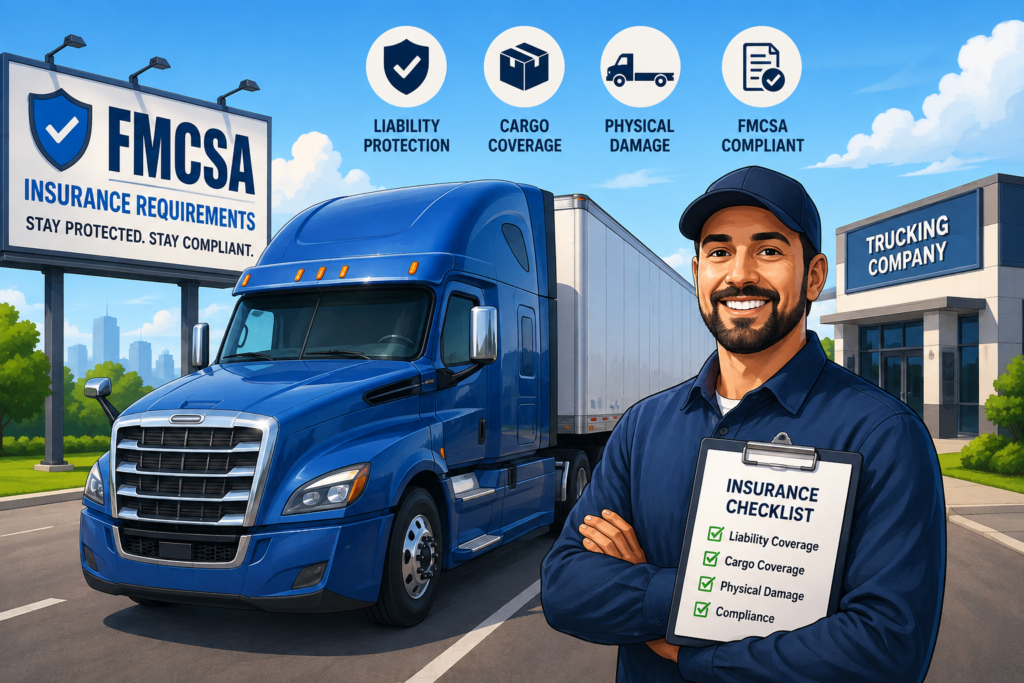
FMCSA Insurance Requirements for 2026
For many for-hire property carriers operating vehicles with a GVWR of 10,001 pounds or more, the federal minimum bodily injury and property damage (BIPD) liability requirement is $750,000.
However, the required amount can be higher depending on the type of cargo and operation.
1. Non-Hazardous Property Carriers
For-hire property carriers transporting non-hazardous commodities with vehicles having a GVWR of 10,001 pounds or more generally have a federal minimum BIPD requirement of:
$750,000
For vehicles under 10,001 pounds, the federal minimum shown by FMCSA is different, so carriers should check the requirements applicable to their specific operation. (FMCSA)
2. Certain Hazardous Materials
For certain hazardous-material transportation operations, the minimum financial responsibility requirement can be:
$1,000,000
The exact requirement depends on the hazardous material and the type of transportation involved. (FMCSA)
3. Explosives, Poison Gas and Radioactive Materials
For certain operations involving explosives, poison gas, radioactive materials, and other specified hazardous materials, the federal minimum can be:
$5,000,000
Hazardous-material requirements can be highly specific, so carriers should verify the applicable FMCSA and PHMSA requirements before operating. (FMCSA)
4. Household Goods Carriers
For-hire household goods carriers operating vehicles with a GVWR of 10,001 pounds or more generally have:
- $750,000 BIPD liability
- $5,000 cargo insurance
FMCSA specifically requires household-goods carriers to maintain both public liability and cargo insurance to obtain interstate operating authority. (FMCSA)
FMCSA Minimum Insurance vs. Broker Requirements
One of the most important things for a trucking company to understand is that the FMCSA minimum is not always the same as the insurance limit required by a broker or shipper.
For example, FMCSA may require $750,000 in federal liability coverage for a particular operation, while a broker may require a carrier to carry $1 million liability before allowing the carrier to haul its loads.
Similarly, a broker or shipper may require a specific cargo limit, such as $100,000 or more, depending on the type and value of freight.
Therefore, before purchasing a policy, check:
- FMCSA requirements
- State requirements, when applicable
- Broker requirements
- Shipper requirements
- Your cargo type
- Your operating authority
- Your lease or contract requirements
Choosing coverage only because it meets the federal minimum may not be enough to satisfy the requirements of the brokers you want to work with.
Documents Needed for a Commercial Truck Insurance Quote
Whether you are opening a new trucking company or already have an established carrier, an insurance agent or insurance company will typically request several documents and details before providing a quote.
Common information includes:
- USDOT Number
- MC Number, when applicable
- Owner and driver CDL information
- Truck and trailer VINs
- Truck and trailer values
- IFTA records for an existing carrier
- Loss runs for an existing carrier
- Garaging or parking address
- Requested insurance coverage limits
Let’s look at each requirement.
1. USDOT Number
If you are starting a new trucking company, you generally need to complete the appropriate FMCSA registration process for your operation.
A USDOT Number is used to identify companies operating commercial motor vehicles in interstate commerce and certain intrastate operations.
Depending on your operation, you may also need operating authority, commonly referred to as an MC Number.
Your specific registration requirements depend on the type of transportation business you operate.
2. Owner and Driver CDL
When requesting a commercial truck insurance quote, the insurance company will generally need driver information.
This can include:
- Owner’s CDL
- Driver’s CDL
- Driver experience
- Driving history
- Previous commercial driving experience
- Whether the owner will drive the truck or only operate the business
If you are hiring a driver, provide accurate information about that driver. Insurance companies use driver information when evaluating risk and determining premiums.
3. Truck and Trailer VIN Numbers
The Vehicle Identification Number (VIN) identifies each truck and trailer you want to insure.
You should provide the correct VIN for every vehicle that will be listed on the policy.
A VIN may be used by the insurance company to verify vehicle information and help determine the appropriate coverage and premium.
4. Truck and Trailer Value
You should provide an accurate value for your truck and trailer.
This information is particularly important when purchasing physical damage coverage.
If you intentionally provide an incorrect value to reduce the premium, you could create problems when a claim occurs.
Always provide accurate information to your insurance company.
5. IFTA Reports for Existing Companies
An established interstate trucking company may be asked to provide IFTA records during the insurance quoting process.
IFTA stands for International Fuel Tax Agreement.
IFTA reporting helps document fuel purchases and mileage traveled across participating jurisdictions.
For an established trucking operation, an insurance company may request recent IFTA reports as part of its underwriting process.
A brand-new company generally will not have historical IFTA reports because it has not yet generated operating history.
6. Loss Runs for Existing Companies
Loss runs are another important document for an established trucking company.
They provide information about previous insurance claims and losses.
An insurance company may request loss runs from your previous insurer or insurance agency when preparing a new quote.
Depending on the insurer’s underwriting guidelines, the company may request multiple years of loss history.
Even if you have not had any claims, your insurer may provide a loss-run report showing no reported losses.
Providing accurate loss information is important because insurers use claims history when evaluating risk.
7. Garaging or Parking Address
The garaging address is the location where your truck is normally parked when it is not being used.
This information can be important to the insurance company because the location where equipment is stored can affect underwriting and pricing.
Always provide your actual garaging or parking location.
Do not provide a false address simply to obtain a lower insurance premium.
If the information provided to the insurer is inaccurate, it can create serious problems with underwriting or claims and may potentially result in policy action depending on the circumstances and policy terms.
8. Choose the Right Coverage
Before purchasing a commercial truck insurance policy, determine what coverage your operation actually needs.
Some of the most common coverages for trucking companies include:
- Auto Liability
- Motor Truck Cargo
- Physical Damage
- General Liability
- Non-Trucking Liability
- Trailer Interchange
- Bobtail Coverage
- Rental Reimbursement
- Uninsured/Underinsured Motorist Coverage
The coverage you need depends on how your trucking business operates, what type of freight you haul, whether you own or lease equipment, and what your brokers or customers require.
New Trucking Company vs. Existing Trucking Company
There can be a significant difference between obtaining insurance for a new venture and an established trucking company.
New Venture
A new trucking company may have limited operating history, so an insurer may focus heavily on:
- Driver experience
- CDL history
- Equipment
- Type of operation
- Cargo
- Radius of operation
- Garaging location
- Safety information
- Requested coverage
- Business experience
Existing Trucking Company
An established company may have additional underwriting information available, such as:
- IFTA reports
- Loss runs
- Previous insurance history
- Claims history
- Current equipment schedule
- Driver history
- Operating history
Having accurate and complete documentation can make the quoting process easier.
Final Thoughts
Understanding FMCSA insurance requirements in 2026 is important before starting or expanding a trucking company.
The federal minimum insurance requirement is only one part of the process. Your actual insurance needs may also depend on your cargo, vehicle, operating authority, broker requirements, shipper requirements, and business operations.
For many non-hazardous for-hire property carriers operating vehicles with a GVWR of 10,001 pounds or more, the federal BIPD minimum is $750,000. However, certain hazardous-material operations can require $1 million or $5 million, while household goods carriers have additional cargo insurance requirements. (FMCSA)
Before purchasing a policy, make sure your insurance agent or carrier understands your complete operation and that the policy meets the requirements applicable to your business.
If you are looking for a complete explanation of commercial truck insurance coverages,Read This Post
A complete explanation of commercial truck insurance coverages
Commerical Truck Insurance Mistakes
Disclaimer: This article is provided for general informational purposes and should not be considered legal, insurance, or regulatory advice. FMCSA requirements can vary based on the type of carrier, cargo, vehicle, and operating authority. Always verify current requirements with FMCSA and consult a licensed insurance professional for your specific situation.