
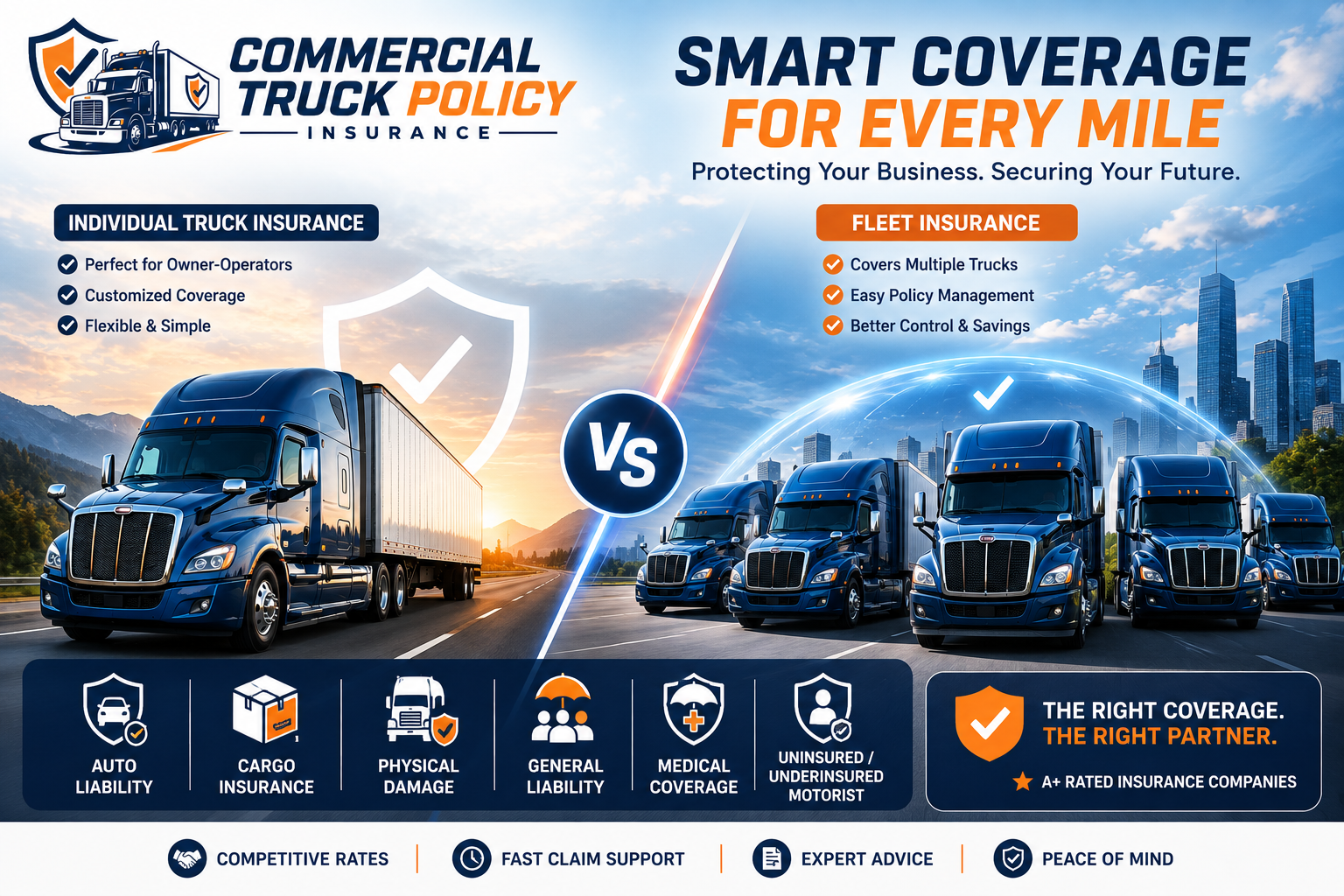
Fleet Insurance vs Individual Truck Insurance: Which Is Better for Your Trucking Business?
Running a trucking business means dealing with many expenses, and commercial truck insurance is usually one of the biggest. If you operate more than one truck, you may eventually face an important question: Should you insure each truck separately, or move to a fleet insurance policy?
Both options can work well. The better choice depends on the number of trucks you operate, your drivers, your claims history, the type of freight you haul, and your plans for growing the business.
In this guide, we will explain the difference between fleet insurance and individual truck insurance, their advantages and disadvantages, and when each option may make more sense.
What Is Individual Truck Insurance?
Individual truck insurance means a truck is insured under its own commercial auto or commercial trucking policy.
This arrangement is common among owner-operators and small trucking businesses that operate only one truck.
For example, if you own one tractor and operate it yourself, you may purchase a commercial truck insurance policy specifically for that vehicle and your business operations.
The premium can depend on several factors, including:
- Type and value of the truck
- Driver’s experience and driving record
- Operating radius
- Type of cargo
- Where the truck is operated
- Coverage limits
- Claims history
- Business experience
Individual insurance can also provide more flexibility when a business has unusual equipment or a truck that has different insurance needs from the rest of the operation.
What Is Fleet Insurance?
Fleet insurance is designed to cover multiple vehicles under one insurance program or policy structure.
Instead of managing a completely separate insurance policy for every truck, a trucking company can place several vehicles under a common policy.
The insurer may look at the overall operation when evaluating the account. Factors can include the number of vehicles, drivers, equipment, operations, and the company’s loss history.
There is not one universal truck count that automatically makes a business a “fleet.” Insurance companies have their own underwriting rules, so eligibility can vary from one insurer to another.
Fleet Insurance vs Individual Truck Insurance
The biggest difference is how the insurance is structured.
With individual truck insurance, each truck is generally handled separately.
With fleet insurance, multiple vehicles are managed together under a broader insurance program.
Here is a simple comparison:
| Feature | Individual Truck Insurance | Fleet Insurance |
|---|---|---|
| Number of vehicles | Usually one | Multiple vehicles |
| Policy management | Separate | Centralized |
| Billing | Can be separate | Often consolidated |
| Renewals | May vary | Usually easier to manage together |
| Driver management | Unit-specific | Fleet-level management |
| Best suited for | Owner-operators and small operations | Growing trucking companies |
| Pricing | Based heavily on individual risk | May consider overall fleet risk |
The exact coverage, pricing, and eligibility will depend on the insurer and the trucking company’s situation.
Is Fleet Insurance Cheaper?
This is one of the most common questions, but there is no guaranteed answer.
Fleet insurance can sometimes reduce the overall cost per vehicle because several trucks are insured together. However, a fleet policy is not automatically cheaper.
Insurance companies consider the complete risk of the business.
For example, a company with six trucks and several serious recent claims may receive a very different quote from a company with six trucks and a strong loss history.
Other factors can also affect the premium, such as:
- Driver records
- Type of freight
- Truck types
- Mileage
- Operating states
- Claims history
- Coverage limits
- Deductibles
- Business experience
So, instead of assuming that fleet insurance will always save money, it is better to compare actual quotes.
Advantages of Individual Truck Insurance
Individual policies can make sense for smaller trucking operations.
1. Good for Owner-Operators
If you operate one truck, maintaining a separate policy can be straightforward.
You generally do not need a large fleet structure when there is only one vehicle.
2. More Unit-Level Flexibility
If one truck has different equipment or a different use than another vehicle, individual insurance may make it easier to structure coverage around that specific unit.
3. Simple for a Small Operation
An owner-operator may find it easier to understand and manage insurance when there is only one truck and one primary driver.
Disadvantages of Individual Truck Insurance
There can also be drawbacks as the business grows.
Managing multiple separate policies may create more paperwork, different renewal dates, separate billing, and additional administrative work.
If you eventually operate several trucks, keeping track of every policy individually can become inconvenient.
Advantages of Fleet Insurance
1. Easier Policy Management
A major advantage is convenience.
Instead of managing several completely separate insurance arrangements, a trucking company can often manage its vehicles through one broader insurance program.
This can make billing, renewals, certificates, and vehicle changes easier to organize.
2. Better for Growing Fleets
Fleet insurance may be more suitable for companies that operate multiple trucks and expect to continue expanding.
Adding another truck can become part of the normal fleet-management process, although the insurer may still need to approve the vehicle and update the policy.
3. One Overall Risk Picture
The insurer can evaluate the trucking operation as a whole, including its vehicles, drivers, operations, and claims experience.
A strong safety and loss history may help a company when negotiating insurance terms, although every insurer uses its own underwriting criteria.
Disadvantages of Fleet Insurance
Fleet insurance is not automatically the right choice for every trucking company.
Higher Overall Exposure
A fleet policy covers multiple vehicles, so the total insured exposure can be significant.
If the business has poor claims experience or high-risk operations, the overall premium may still be substantial.
Less Useful for Very Small Operations
If you have only one truck, there may be little practical benefit in looking for a fleet arrangement.
Underwriting Can Be More Detailed
Larger trucking operations may need to provide more information about drivers, vehicles, operations, safety practices, claims, and other business details.
What Coverage Can a Trucking Business Need?
The exact insurance package depends on the operation.
Common commercial trucking coverages can include:
- Primary liability
- Physical damage
- Motor truck cargo
- General liability
- Non-trucking liability
- Bobtail coverage
- Trailer coverage
- Medical payments, where applicable
- Rental reimbursement or downtime-related coverage, depending on the policy
Not every trucking business needs every coverage.
For example, a carrier hauling freight for customers may have different insurance needs from an owner-operator leased to another motor carrier.
What About FMCSA Insurance Requirements?
Federal insurance requirements depend on factors such as the type of carrier, vehicle, cargo, and operating authority.
For example, FMCSA currently lists a $750,000 minimum BIPD requirement for for-hire property carriers transporting non-hazardous property with vehicles having a GVWR of 10,001 pounds or more, subject to the applicable federal rules. Higher limits can apply to certain hazardous materials operations. (FMCSA)
These federal minimums should not be confused with the amount of insurance a broker, shipper, lender, lease agreement, or customer may require.
Always verify the requirements that apply to your particular operation before purchasing coverage.
Which Option Is Better for You?
The answer depends mainly on your business size and future plans.
If You Own One Truck
Individual truck insurance is usually the more natural starting point.
It keeps the policy structure relatively simple and allows the insurer to rate the operation based on that particular truck and driver.
If You Operate Several Trucks
Fleet insurance may become worth considering.
The convenience of managing multiple vehicles under one insurance program can become increasingly valuable as your operation grows.
If You Are Planning to Expand
Even if you currently have only a few trucks, it can be useful to ask an insurance agent about fleet options before adding more vehicles.
You can compare the cost and administrative differences before making a change.
Example: One Truck vs. Five Trucks
Imagine two trucking businesses.
Company A
Company A operates one tractor and the owner is the primary driver.
An individual commercial truck policy may be a practical solution.
Company B
Company B operates five tractors with several drivers.
Managing five separate insurance arrangements may create more administrative work. A fleet policy could provide a more centralized approach, depending on the insurer’s eligibility rules and pricing.
The important point is that the number of trucks alone does not determine which option is cheapest. The company’s overall risk profile matters too.
Questions to Ask Before Choosing a Policy
Before buying or changing trucking insurance, ask the insurance agent:
- Is my business eligible for a fleet policy?
- What will the total premium be for each option?
- Are all of my drivers eligible?
- What liability limits are required for my operation?
- Do I need motor truck cargo coverage?
- What deductible applies to physical damage?
- Are there any restrictions on where I operate?
- How will adding another truck affect my premium?
- How will my claims history affect the renewal?
- Are certificates of insurance easy to obtain when customers request them?
Getting answers to these questions can help you compare policies based on more than just the initial premium.
Final Thoughts
There is no universal winner in the fleet insurance vs. individual truck insurance debate.
For an owner-operator with one truck, individual commercial truck insurance may be simpler. For a growing trucking company with several vehicles, fleet insurance may provide better organization and potentially better pricing.
The smartest approach is to compare quotes based on the same coverage limits, deductibles, drivers, vehicles, and operations.
A cheaper policy is not necessarily a better policy if it leaves important gaps in coverage.
Before purchasing insurance, review the policy carefully and confirm that it meets both your business needs and any applicable federal or contractual requirements.
Disclaimer
Disclaimer: This article is for general educational purposes only and does not provide insurance, legal, or financial advice. Insurance requirements, coverage terms, and premiums vary by carrier, state, operation, and individual risk. Always confirm current requirements and policy terms with a licensed insurance professional and the appropriate regulatory authority.
What Is an MCS-90 Endorsement?
Best Commercial Truck Insurance Companies in USA
FMCSA Insurance Requirements 2026: Complete Guide for Trucking Companies
Thank you for the detailed information and for explaining everything so clearly. You did a great job helping me understand the process. I really appreciate your effort and support. Great work! 👍